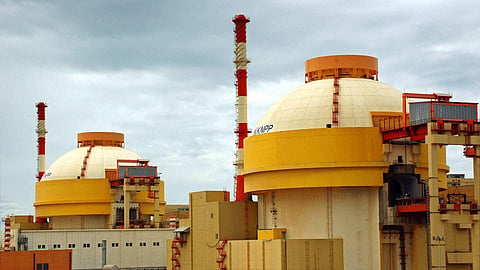

CHENNAI: The Kudankulam Nuclear Power Plant (KKNPP) in Tirunelveli has conveyed that the tentative tariff for the power it will be supplying to Tamil Nadu Power Distribution Corporation Limited (TNPDCL) from its upcoming 3rd and 4th unit will be Rs 5.95 per unit.
TNPDCL presently has an allocation of 1,152 MW out of the 2,000 MW generated by units 1 and 2 of KKNPP, which is bought at a cost of Rs 4.10 per unit. With the assurance from Union Ministry of Power (MoP) that the allocation of power to TNPDCL from units 3 and 4 with a total capacity of 2,000 MW will be 50% besides the unallocated share, the state’s discom is expected to pay 45% more per unit.
A senior official, however, said that the tariff is yet to be finalised. The union government’s Department of Atomic Energy determines the tariff for nuclear power plants in consultation with MoP.
A top official source in the state-run power utility said the decision about the tariff has been conveyed to TN, but formal clearance from the centre is still awaited. According to the Nuclear Power Corporation of India Limited (NPCIL), which operates KKNPP, unit 3 with 1,000 MW capacity is expected to be commissioned by December 2026 and the unit 4 of same capacity a year later. The increased tariff is believed to be due to the significantly higher project cost for units 3 and 4 compared to the other two.
In 2023-24, TNPDCL bought 8,381 million units of power from KKNPP at a total cost of Rs 3,784 crore.
Nuclear power relatively expensive: TNPDCL
Though the discom may have to pay around Rs 5,500 crore for the same quantum of power from units 3 and 4, sources said this could reduce the discom’s dependency for power from elsewhere to meet its demand.
A senior TNPDCL official said the construction work on units 3 and 4 began during 2016-17 and about 70% of the work has been completed so far. “For the past few years, TNPDCL has been repeatedly requesting NPCIL to share the tentative tariff for the upcoming units. The matter was also discussed several times at meetings of the Southern Regional Power Committee. We have now received a tariff indication, which can be taken up with the union government for negotiations, if required,” the official said. He added that Tamil Nadu has sought allocation of 100% of the power generated from units 3 and 4. “However, the centre has indicated that only 50% power can be allocated to the state, along with 15% of unallocated power. Even this allocation is yet to be confirmed. The union government has also assured that if other southern states do not take their share, Tamil Nadu’s allocation may be increased,” the official added.
In the SRPC meetings, TNPDCL has been insisting the need to finalise the allocation details and tariff to facilitate accurate transmission planning and financial forecasting. Moreover, the discom had highlighted that the implementation of transmission systems to evacuate power from the upcoming units without these details could lead to redundancy and financial implications.
Pointing out that TN’s peak power demand may touch 27,541 MW by 2027 and further rise to 35,507 MW by 2035, another official said the state has therefore been prioritising green energy sources such as solar and wind, along with battery energy storage systems.
“The cost of electricity from these sources is below Rs 5 per unit. Nuclear power is relatively expensive,” he added.
He further said TNPDCL would have to negotiate with the NPCIL to bring down the tariff. “If power can be procured at around Rs 4 or Rs 5 per unit, it will help the discom save a significant amount of money, which can then be used for other development works,” the official suggested.
