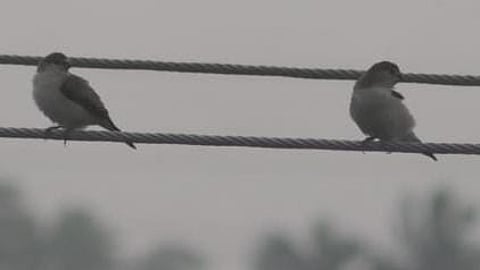

THOOTHUKUDI: Thousands of rosy starlings, a migratory bird species from Eastern Europe and northwest Asia, have descended on water bodies and urban areas across Thoothukudi.
Huge flocks of birds were spotted along the Thamirabarani wetlands, agricultural fields, salt pans, beaches, and even urban settlements. The rosy starling (Pastor roseus), known for controlling locust populations, feeds mainly on locusts, worms, and flying insects, and usually roosts on tall trees. The species typically arrives in the region during the months of November and December.
Wildlife documentarian G Manivanan said he witnessed a murmuration of rosy starlings at Pattinamarudhur. “Local bird species flew away from their nests as the rosy starlings occupied the trees,” he said.
Bird watcher Thomas Mathibalan told TNIE that he observed a large flock at the Perungulam tank. “At least 8,000 rosy starlings are swirling in the sky this year, compared to only a few hundred in the previous years,” he said. According to him, the birds descend on the babul trees near the Perungulam tank around 5 pm every day.
With most of the tanks in the region filled with water, Perungulam tank — fed by the Thamirabarani river — has emerged as a major roosting site. The babul trees planted under the social forestry scheme have become crucial for the birds, and birders have urged the district administration to protect them.
However, farmers cultivating minor millets such as cumbu and cholam have raised concerns, claiming the birds damage crops awaiting harvest.
Ashoka Trust for Research in Ecology and the Environment (ATREE) associate professor Mathivanan said rosy starlings have been visiting Tamil Nadu consistently over the past five years and are increasingly being spotted in urban areas this season.
