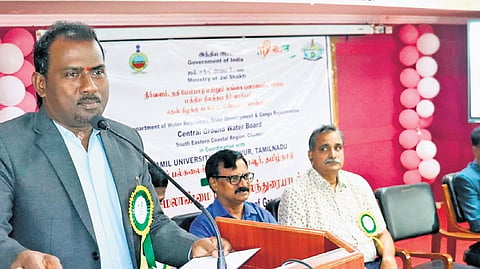

THANJAVUR: The Union government’s Central Ground Water Board (CGWB) has prepared a master plan for creating groundwater recharging structures in Tamil Nadu which envisages an expenditure of `3,500 crore.
The plan will be implemented in a phased manner so that the blocks which are now categorised as semi-critical, critical and overexploited could be turned for inclusion in the safe category for groundwater extraction, said M Sivakumar, regional director (South Eastern Coastal Region)of the central board.
Addressing media on the sidelines of an interaction programme on ‘Sustainability of Groundwater Resources’ held at Tamil University, Thanjavur, on Friday, Sivakumar said only 30% of the area in the state is categorised as safe for groundwater extraction while the remaining 70% falls under the semi-critical, critical and overexploited categories. At the all-India level the average safe area is 60%, he added.
Pointing out that 246 of the total 385 blocks in Tamil Nadu fall under the semi-critical, critical and overexploited categories, the official said, “The higher exploitation of groundwater in the state reflects its level of development in the industrial and agriculture sectors.”
Stressing the need to improve water use efficiency in the agriculture sector as it uses up “80% of the groundwater as well as surface water”, the CGWB official suggested alternative cultivation practices like drip irrigation and sprinkler irrigation, and adopting wet and dry methods for it.
Responding to a question, Sivakumar said Automated Digital Water Level Recorders with Telemetry has been installed at 1,000 vulnerable points across Tamil Nadu to transmit alerts in the event of the water turning saline. The same will be conveyed to the state government for remedial action, he added.
Recharge structures
According to the CGWB website the recharge structures proposed under the master plan for Tamil Nadu include recharge shafts, borewells, check dams, farm ponds and percolation ponds
