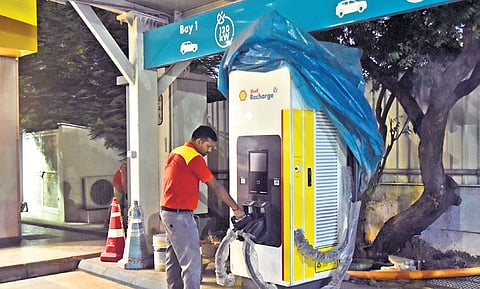

CHENNAI: Electric vehicle charging operators in Tamil Nadu are bracing for higher electricity bills as the state’s power regulator raised both energy and fixed charges under a revised tariff structure, effective July 1. The Tamil Nadu Electricity Regulatory Commission (TNERC) has retained its time-of-day (ToD) model for EV charging — first introduced in 2023 — but increased rates across the board, triggering fresh concerns about the economics of public charging.
Energy charges under the new structure now range from Rs 6.50 per kWh during solar hours (9am–4pm) to Rs 9.75 during peak hours (6am–9am and 6pm–10pm), up from Rs 9.45. Night charging (10 pm–6 am) is priced at `8.10, compared to Rs 7.85 earlier. More significantly, fixed charges for high-tension (HT) charging stations have more than doubled, from Rs 145 to Rs 304 per kVA per month. Unlike energy charges, these apply regardless of usage and are based on sanctioned load. For example, a 50kW fast-charging station will now pay Rs 2,750 in monthly fixed charges, up from Rs 1,300 (excluding electricity tax).
“Our average cost of power was around Rs 9 to Rs 9.50 per kWh before July. Following the tariff revision, it has gone up by Rs 2.50 per unit — a 20% increase in our power cost,” said K P Karthikeyan, director of Indian Charge Point Operators Association. “This is a fixed cost, and while the impact could taper as utilisation improves, public charging stations typically operate at just 5-6% utilisation, and rarely exceed 10%. Even in the best-case scenario, utilisation levels may not cross 15-16%. So, at current usage levels, the hike effectively translates to a 20% cost escalation.”

Industry executives say such steep hikes disproportionately affect operators who are already struggling with low volumes. “We are required to take a sanctioned load equal to the charger capacity. Even if utilisation is low, these fixed charges are unavoidable,” said Jagadeesan Balaji, head of finance and HR at Zeon Charging. “With this revision, what we expected as a five-year breakeven may now stretch to eight or nine.”
The Tamil Nadu government, through its discoms — Tamil Nadu Electricity Distribution Corporation Ltd (TNEDCL) and Tamil Nadu Power Distribution Corporation Ltd (TNPDCL) — defended the revision, noting that the hike was necessary to reflect the actual cost of servicing high-capacity EV infrastructure.
Tamil Nadu has around 3,000 public EV charging stations, with utilisation rates typically between 8-15%. Most two and four-wheeler users still charge at home or at workplace, limiting daily volumes at public stations. Operators say these facilities primarily serve long-distance and commercial segments. “Public charging is driven by travel need, not electricity pricing. People don’t plan trips around tariff windows,” said Balaji.
End-user tariffs typically range from Rs 10–Rs 18 per unit for two and three-wheelers, and Rs 15–Rs 25 for fast-charging cars, taxis and fleet vehicles. With operators functioning under public-private partnerships or independent models, the ability to pass on the full cost hike remains constrained.
While fixed charges under the low-tension (LT–VII) category have also been increased and tiered by connected load, operators say broader policy inconsistencies are undermining the state’s EV push. Only HT consumers are permitted to wheel renewable energy — a key cost-saving tool— but HT connections remain significantly costlier in Tamil Nadu compared to states like Karnataka or Kerala. Operators also point to ongoing delays in smart meter rollout and grid interconnection approvals.
The current hike follows a sharp tariff reduction in FY2023–24, when rates were slashed by nearly 50% to incentivise investment. While TNERC had flagged a gradual revision path, operators say the lack of multi-year clarity continues to deter investors.