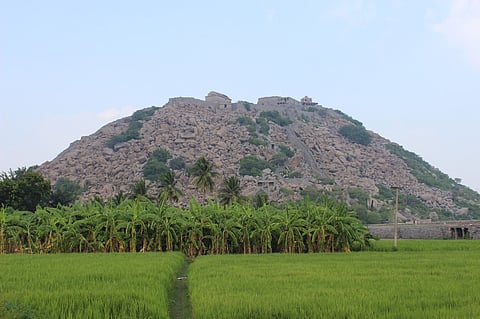

VILLUPURAM: Gingee Fort, one of South India’s most formidable and historically rich forts, located 40 kilometres from Villupuram has officially been inscribed as a UNESCO World Heritage Site on Saturday.
Hwajong Lee, an expert from the International Council on Monuments and Sites (ICOMOS), visited the site on September 27, 2024 for the assessment.
The inclusion comes as part of a broader recognition of 12 forts associated with Maratha emperor Chhatrapati Shivaji’s Military Landscapes. While 11 of these forts are located in Maharashtra, Gingee Fort stands as the only one outside the state, highlighting its strategic significance during the Maratha reign.
The UNESCO recognition not only validates the fort’s architectural and cultural significance but also opens new avenues for tourism and economic development in the district.
District Collector Sheik Abdul Rahman told TNIE that this paves way for the district administration to develop commercial outlets at the site for foreign and other state visitors. “With the panchayat, and Tamil Nadu Tourism departments the administration will uplift the Fort area in Gingee town to increase revenue through tourism” he said.
As the heritage site now stands poised to welcome a global audience to explore its remarkable legacy, the maintenance of the sites need improvement. Sources stated that the toilet facilities at Krishnagiri (Queen’s Fortress) gate of the Fort are locked and drinking water facilities were not available. However, in the Rajagiri (King’s Fortress) gate, toilets were available for free but drinking water had to be bought from the shops.
During May this year, TNIE reported on the issue that left visitors suffer during the summer vacations. Similarly, the site offers a tedious trek 800 metres uphill through rock stairs and occasional porches on either side of the hills to rest. The site lacks sign boards directing the way forward, pitstops, steep hills and other significant alerts for the trek. However, a detailed site description inscribed on a metal plate is displayed at the foothills, by ASI. .
Writer and archaeology enthusiast, K Senguttuvan said that UNESCO’s recognition is an honour to the 348-year-old history of Gingee Fort.
Speaking to TNIE, he said, “It is a happy moment for us who have been longing to get attention on the archaeological and historic significance of Villupuram district, which has in itself a wide range of history and culture. This will be a precedent to unravel the more historic truth of the region, I hope.”
The History
Located in Villupuram district, Gingee Fort is believed to date back to the 13th century and has seen a succession of rulers including the Cholas, Vijayanagara Empire, Gingee Nayaks, Bijapur Sultans, Marathas, Mughals, French, and British. Its architecture is a testament to the layered history of South India, with temples, mosques, palaces, and military structures bearing the marks of various dynasties.
Historians claim that Chhatrapati Shivaji captured Gingee Fort in 1677 from the Bijapur Sultans and transformed it into a powerful military outpost. Jesuit missionary Andrew Breira recorded Shivaji’s extensive fortification efforts in 1678, stating that the modifications were so precise that even European engineers would have admired them. These enhancements later helped the Marathas hold off a Mughal siege for seven years.
The Gingee Fort is enclosed by a 13 km rampart and spread over 11 sq km, it is flanked by three hills—Rajagiri, Krishnagiri, and Chandrayan Durg—with a fourth, smaller hill, Chakkili Durg. Rajagiri, the tallest, features citadels, temples, and a deep chasm. The fort complex includes temples, mosques, and Indo-Islamic structures. Praised by Shivaji as the most impregnable fort in India and called the “Troy of the East” by the British, it was declared a national monument in 1921.
The Lower Fort complex of Gingee Fort houses the Venkataramanaswami temple, noted for its intricately carved doorway depicting scenes from epics and Puranas. Nearby lies Anaikulam, or Elephant Tank, believed to have served royal elephants, with Chakrakulam and Chettikulam tanks to its west.
A highlight of the Inner Fort is the Kalyana Mahal, an architectural gem featuring an eight-storeyed tower with a pyramidal shikhara, set on a square platform surrounded by rooms likely used by royal women.
