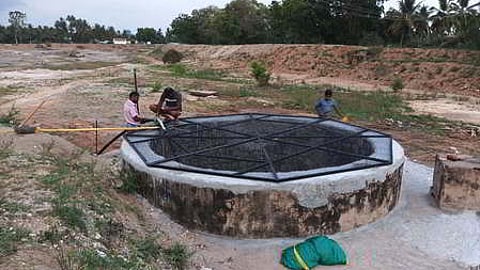

COIMBATORE: An abandoned open well located within a waterbody at Rayarpalayam near Sulur in the district has become a model for an economical water distribution system, thanks to the Athikadavu-Avinashi groundwater recharge project.
The waterbody conservation forum 'Kousika Neerkarangal' revived the well, establishing it as a primary groundwater source for the village, while replacing the previous borewell supply. The NGO claims that the open well can save around 220 units of electricity each day and around Rs 1 lakh in electricity costs every two months when compared to the conventional borewell water supply.
The well was found a month ago while desilting the Rangasamuthiram Lake- a tank spanning around 25 acres in the Pathuvampalli village panchayat of Sulur taluk. "The well is located at the northwest corner of the tank and is one of the 1,230 waterbodies benefitting from the Athikadavu-Avinashi groundwater recharge project.
This project rejuvenates the groundwater source of the tank, allowing us to identify the well, which holds water at a depth of 75 feet. After desilting and cleaning the well, we repaired its structure. With a Total Dissolved Solids (TDS) level below 350 mg/L, the water from the well has been supplied to the village, replacing borewell water, whose TDS levels were above 700 mg/L," said PK Selvaraj, founder of Kousika Neerkarangal.
While the well provides quality drinking water, it also consumes less electricity. The village, with a population of 1,800, requires 50 litres of water per person daily, at a total of 90,000 litres of water. Previously, this was sourced from borewells, and two pumps with 7.5 horsepower were operated. "Each pump consumes about 11 units of electricity per hour and operates for approximately 12 hours.
As the cost of electricity is Rs 8 per unit, the panchayat used to spend Rs 1.26 lakh every two months to operate these two pumps for groundwater supply. However, in the well, we can draw clean water from just 75 feet, allowing us to collect around 25,000 litres of water per hour with a single pumpset. In just four hours and using only 44 units of electricity, we can provide the same amount of water as the borewell, costing only Rs 21,000 for two months," K Balakrishnan of the agriculture wing of Kousika Neerkarangal said.
PK Selvaraj said that the open wells located in areas covered by the Athikadavu-Avinashi groundwater recharge project have abundant groundwater resources. He urged the government to take the initiative to desilt and operate these open wells as an alternative to borewells. The revival of this well was made possible through CSR funding, and it serves as an exemplary model for sustainable water management, Selvaraj added.
