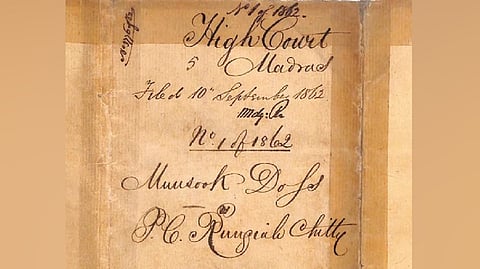

CHENNAI: Not so long ago, the judges had to rummage through hundreds of pages of the voluminous “case bundles” to find the required parts of an old judgment or case paper. If the case bundles are readily available, they can save time and energy; if not, it will take several hours or days, delaying the process of hearing cases and delivery of justice.
But the situation has unimaginably changed over the last few years. Now, the judges can find the required parts or full copies of the judgment or case papers within a fraction of a second by the click of a mouse.
This has become a possibility because of a silent revolution taking place through the “digitisation” of court records belonging to the principal bench in Chennai and the Madurai bench including judgments, documents of writ, criminal, judicial and original side cases and administrative files under the guidance of the Supreme Court. The project is being funded by the centre and the state government.
The Herculean task of converting the physical records into digital format is being carried out by a dedicated team of officers, employees and retired staff.
The project of digitisation was given a big impetus with the high court’s committee for digitisation headed by Justice M Sundar paying utmost attention to the task. The other members of the committee are Justices G R Swaminathan, Senthilkumar Ramamoorthy, R Vijayakumar and C Kumarappan.
A standard operating procedure has been put in place. The process involves different levels of verification of the original papers and the scanned copy before clearing the scanned copy for storage. Inward entry/inventory, sorting and arranging records, weeding out immaterial parts, indexing, paginating and outward entry are pre-scanning activity.
Once the records are scanned, the post-scanning level of verification is done. The dedicated team for post-scanning check will compare the hard copies with the scanned copies, check to ensure all the papers are scanned and are legible, and metadata entries are made properly. In case of errors, the scanned copies will be sent back for fresh scanning.
The scanned copies can be sent for storage in the document management system (DMS) only after the officers concerned put the digital signature on the files. Finally, they are stored in the storage area network (SAN).
Disaster recovery centre
A robust storage and backup system has been put in place to preserve the digitised records forever in the principal bench and Madurai bench. A disaster recovery centre has been set up in Madurai. Incidentally, when the national capital faced some natural calamity situation a few years ago, the digital records of the Delhi High Court were moved to the disaster recovery centre in Madurai, earning the appreciation of the Supreme Court.
District judiciary
The project for digitising the records was extended to the district judiciary as well.
As many as 250 crore pages of legacy and administrative files have approximately been quantified in 825 courts in the district judiciary. As many as 10.62 crore pages of fresh and pending case records have been scanned till July 15, 2025.
Currently, the task is being carried out at 17 districts and will be launched soon in the remaining districts. In the last one month, one crore pages of legacy records have been given the digital form.
Key advantages
*Increases productivity, speeds up disposal of cases and improves quality of justice delivery system
*Saves energy and precious time
*Reduces manual work
*Makes easy to search required document
*Easy to handle, read and copy
*Saves plenty of space which was occupied by physical record bundles
High Court
*Legacy /Pending/Fresh Administrative records
*17.44 crore pages scanned in principal bench and Madurai bench
*12.93 crore pages have been approved
Fresh and current cases
*3.35 crore pages scanned in principal bench
*1.22 crore pages scanned in Madurai bench
District judiciary
*250 crore pages of legacy and administrative files quantified
*10.62 crore pages of pending case records have been scanned so far
