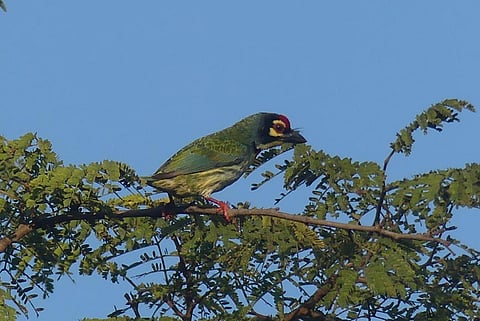

VELLORE: “Look! A coppersmith barbet perched on a tree trunk!”, “There flutters a malkoha!”, “Here goes a babbler!” — whispered voices broke the morning stillness of Palamathi Hills—at 6 am on Sunday. These were the voices of around twelve nature enthusiasts, mostly college students from Chennai and Vellore, who had gathered to volunteer for the bird census conducted by the forest department as part of the state-wide annual survey.
The terrestrial census was led by M Murugan, the forest range officer of the Bagayam Social Forestry Department. Silencing the team, he instructed, “Walk quietly and observe so that the birds are not disturbed.” Over the past few days, he had provided the team with a briefing on bird identification and observation techniques.
The sighting of a coppersmith barbet, a green bird with a red head, yellow cheeks, and a yellow throat-sparked the most excitement among the team. “It is a common bird in our region, but we haven’t seen it in a long time,” Murugan told TNIE. He then ventured onto a side path from the main route to capture the bird on camera, accompanied by another volunteer, Sam, who works at a university in the district.
One of the volunteers, Soumya from DKM College, Vellore, was assigned the task of recording the names of birds as they were spotted. “Write down the species name once and add a plus one whenever it is sighted again. It is also important to note the bird’s behaviour at the time of spotting, whether it is flying, or simply perching,” Murugan explained to the students.
Some of the birds spotted included mynas, red-vented bulbuls, tree pies, iora, oriental white-eye and spotted doves. The moment a bird was sighted, the lone pair of binoculars was passed around, allowing everyone in the team to get a closer look. Two volunteers, including Murugan, tried to capture images of the birds, while others referred to a field guide containing illustrations and descriptions of various species.
To ensure accuracy, volunteer S Balakumar, an MNC worker in Chennai, reiterated each bird’s name to Soumya so that no species were left unrecorded. “The method we are using is called the transect method. We walk, and if a bird is spotted nearby, we move in that direction to observe and document it. This differs from the wetland census, where we stay in one place and observe the surroundings,” Murugan explained.
Drawing attention to the humming, continuous calls, and ‘tak-tak’ sounds of birds, he stressed that one should not rely solely on auditory cues but must confirm sightings visually before recording them. Recalling an anecdote from his department’s training sessions, he shared, “Once, we were asked to sit at various points in a forest for three hours, simply listening and identifying as many sounds as possible.”
In parting, he said that this was only a sample approximation and that it would be nearly impossible to count every bird with absolute accuracy.
