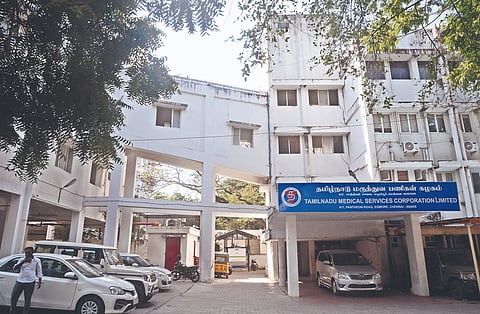

CHENNAI: Lakshmanan (name changed), a sexagenarian, who regularly gets medicines for his neurological condition from the Government Kilpauk Medical College in Chennai, still remembers how the supply and packaging of medicines used to be terrible at the facility years back, unlike these days.
Shortage of essential medicines, sporadic supply and poor packaging of clinical drugs remained a major concern in government hospitals across Tamil Nadu, particularly in the early 1990s, making reforms in procurement methods necessary to supply quality medicines to the poor, without any shortage. The necessity of the situation forced the state government to find a long-term solution, which turned into reality in 1994, with the establishment of the Tamil Nadu Medical Services Corporation Limited (TNMSC), under the Companies Act, 1956.
Fast forward to 2025, pharmacists in government hospitals are now busy storing fresh stocks of medicines, and distributing appropriate ones to the patients lined up at the pharmacy counters. “Now the packaging looks attractive and the medicines are of good quality," adds Lakshmanan, who collects his drugs every 15 days or occasionally every week. “If there is a short supply of stocks, they give me drugs for a week, and ask me to come later. But, not once has there been a complete shortage of drugs and I was turned down,” he noted.
According to R Poornalingam, former health secretary, who was instrumental in setting up TNMSC, the corporation was established when there was a perennial shortage of drugs, coupled with quality issues. Hence, the state government wanted to reform the procurement to supply quality medicines, sans shortage.
“The TNMSC operates on a supply chain management system and is IT driven. It took one-and-a-half years for us to set up the company. Since then, there has been no shortage of medicines at public health facilities, nor any compromise on quality. The procurement system was transparent and system-driven, such that TNMSC could procure medicines at competitive rates. This saved 36% of the drug budget for the health department. Around 300 medicines in the Essential Medicines List of World Health Organization (WHO) were procured and distributed, meeting 90% of the people’s needs,” Poornalingam said.
Later on, the passbook system was introduced for health facilities to collect the medicines from TNMSC. This enabled the facilities to merely show the passbook and get the required medicines within their budget; a system much alike the one wherein customers purchase their essentials from supermarkets using credit cards.
Recognising TNMSC’s success, the Union Health Ministry wanted to introduce the same system for its programmes like TB, Malaria and also for procurement of vaccines. “So, I provided the consultation for them,” added Poornalingam.
The TNMSC Model
TNMSC is a nodal agency for procurement of drugs, medicine, surgical consumables and sutures. Presently, 313 essential drugs, 280 surgical and suture consumables and 326 speciality drugs are procured by TNMSC for use in government medical institutions, according to the policy note of 2024-2025. It also procures 202 veterinary drugs annually for the animal husbandry department, as well as 139 lab reagents and other diagnostic kits. Adequate stock for three months is made available at its 32 warehouses, across the state.
The TNMSC model in public procurement has been hailed by the World Bank and the World Health Organization, and its success prompted the central government to adopt a similar system at the national level.
Besides, official representatives from WHO, Dr H M K Wikramanayaka, Minister of Health, Sri Lanka, Dr Kailesh Jagutpal, Minister of Health and Wellness, Representative of Mauritius, and Ahmed Azyan Hameed, Minister of Finance, Maldives had visited TNMSC in 2023 and observed the practices being followed in procurement of drugs, medicines, surgical, sutures and medical equipment. Further, a team of officials from Maharashtra Medicine and Equipment Procurement Authority, Andhra Pradesh Medical Services and Infrastructure Development Corporation (APMSCL) and Meghalaya Medical Drugs and Services visited TNMSC in 2023, and observed the systems and processes in the corporation.
TNMSC: Missions and Goals
The Tamil Nadu Medical Services Corporation limited was incorporated as a government company fully owned by the government in 1994. It was set up to streamline the procurement of drugs and other medical supplies effectively through a centralised system in the country. Achieving the objective to supply drugs to the public without any interruptions, it proved a model to be replicated by other states. Additionally, the procurement and supply of medical equipment and its maintenance at government hospitals is also conducted by TNMSC, along with the procurement of mother and child health nutrition and care kits, and menstrual hygiene kits for government schemes.
Roles and responsibilities
* Operation and maintenance of high-end therapeutic equipment like linear accelerator, cobalt therapy and brachytherapy
* Extending logistical support in maintenance and operation of pay wards in government hospitals
* Finalisation of rate contract for housekeeping and security services, diet supply, disposal of biomedical waste, oxygen supply and laboratory services to government hospitals
* Operation and maintenance of advanced diagnostic equipment like computed tomography (CT), Magnetic Resonance Imaging (MRI) and lithotripsy through collection of user charges
* Maintenance of special pay wards in hospitals
In light of TNMSC’s proven success, the procurement of drugs for the newly launched Mudhalvan Marundhagam scheme was also entrusted with the corporation. It procures generic medicines for CM pharmacies, which could sell medicines not only at a price cheaper than private pharmacies but also cheaper than the Jan Aushadis run by the union government for many medicines.
“TNMSC has been a pioneer in public procurement. Studious practice of empanelling the suppliers is one of the reasons for its success. One significant aspect about the TNMSC is that it is the only corporation which has a prompt payment system. We assure payment on a designated date. After the companies supply the drugs, these are subjected to a quality test first, and upon receipt of a positive report, it takes hardly 21 to 30 days for payment settlement,” said a senior TNMSC official.
The official added that the companies participating are routinely aware of this. “They have tried supplying to other state procurement agencies, but this kind of prompt payment system is not followed anywhere else, the official asserted.
“Our empanelment consists of technical evaluators, and the credentials of the company are scrutinised thoroughly. In addition to this, we send our own team to the factory site, assess their production capacity, good compliance towards their own manufacturing practices, and we catch hold of companies that have the ability to supply. At first, assured purchase order for the stipulated quantity is placed. We always try to keep the manufacturing factories and premises live, and hence it will be running all days. These are the certain systems developed over the years in our regular procurement for government hospitals,” the official added.
It may be noted that the same method was inculcated in the tender documents of Mudhalvar Marunthagam scheme as well. Apart from this, all the participants were asked to provide the best possible rates. After receiving the orders, the batches are submitted to quality tests in government laboratories. Only those drugs that pass quality tests will be distributed to warehouses, and the same has been reciprocated for Mudhalvan Marunthagam scheme. In case of opting for a single destination delivery, instead of limited delivery points, the cost of drugs can be brought down further.
‘Mudhalvar Marunthagam’ scheme was inaugurated by Chief Minister M K Stalin on February 24, 2025. The scheme includes 1,000 pharmacies across the state, offering up to 25% discount on medicines purchased from the facilities.
