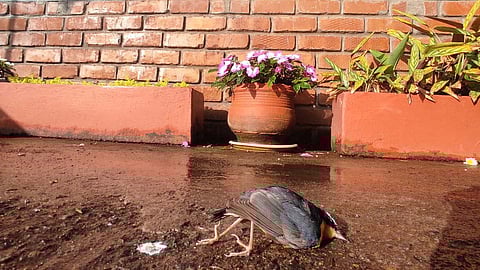

NILGIRIS: A group of researchers documented collision of birds with glass surfaces in Forestdale and Coonoor. The team recorded 35 incidents involving 22 different species from 15 families, of which 16 birds were killed and 18 injured. The ‘Indian blue robin’ (Luscinia brunnea) had the highest number of collisions, followed by the Greenish warbler (Phylloscopus trochiloides), Kashmir flycatcher (Ficedula subrubra) and Grey wWagtail (Motacilla cinerea).
Among resident birds, the White-cheeked barbet (Megalaima viridis) and Spotted dove (Spilopelia chinensis) were the most affected, followed by the Brown wood owl (Strix leptogrammica), Common barn owl (Tytoalba), Hill swallow (Hirundo domicola) and Red-whiskered bulbul (Pycnonotus jocosus), with two collisions each.
The study with the topic ‘Glass traps: Investigating bird mortality at glass-fronted buildings in the Nilgiris’ was conducted between January and December in 2024 by researchers N Moinudheen, K Rishi, A Abinesh, Azad Kamil, Yeshwanth Kumar, E Vignesh and A Samson. The study was published in Ornis Hungarica journal on Friday.
The study was conducted at commercial buildings surrounded by gardens, with nearby forested areas comprising semi-evergreen forests and shola, while non-forest areas primarily consisted of tea plantations at Forestdale and Coonoor.
"Despite the growing concern over bird-window collisions worldwide, research on this issue in India remains limited. Such collisions pose a significant but underexplored threat to the avian biodiversity in the country. In our study, a first of its kind in South India, we have noticed that building architecture, especially reflective glass surfaces, played a crucial role in increasing collision risks. Collisions peaked during winter, highlighting seasonal vulnerability," said Moinudheen.
A Samson said, "With increasing urbanisation, habitat fragmentation and glass reflections pose serious risks to birds, making these collisions an emerging conservation concern. The data indicate that resident birds — White-cheeked barbet and Spotted dove — experience more collisions than other migratory species, likely due to their year-round presence and frequent interactions with human-altered environments."
To prevent deaths and injuries to birds, researchers have urged building owners to fix UV-reflective films and make modifications to the windows.
"Simple interventions, such as circular-shaped decals, patterned glass in high-risk areas and relocating vegetation away from reflective surfaces can help minimize collision risks. Birds possess a broader visual spectrum than humans, extending into the ultraviolet range. Research indicates that UV-reflective films such as BirdShades can effectively reduce collisions by enhancing glass visibility to birds while remaining mostly unnoticed by humans," Rishi pointed out.
"We have recorded 16 deaths in only two areas. Think about the number of bird deaths and injuries that have gone unnoticed. It is time for the forest department to carry out a detailed study," said Azad Kamil