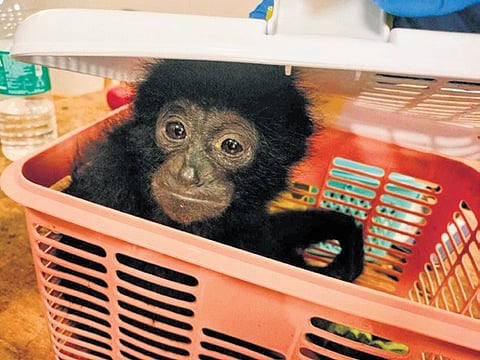

CHENNAI: An analysis by the international wildlife trade monitoring body TRAFFIC has found that gibbon trafficking has hit a peak in 2025, with Chennai, Bengaluru, and Mumbai emerging as key nodes in the global illegal trade, fuelled by India’s growing appetite for exotic pets. Gibbons — small apes native to 11 Southeast Asian countries from northeast India to Indonesia — have increasingly been smuggled into India via air routes from Thailand and Malaysia. Customs officials at the three airports have intercepted several such attempts over the past four years.
In September, a baby Siamang Gibbon, native to Indonesia, Malaysia, and Thailand, was rescued in Tiruvottiyur in North Chennai. Forest officials believe it escaped from a house where it was being kept as a pet. According to TRAFFIC’s analysis released on October 24, at least 336 gibbons were seized across South and Southeast Asia between January 2016 and August 2025, with 20% of the confiscations reported this year alone. Indonesia and Vietnam accounted for the highest seizures, though recent data show a growing shift towards India and Malaysia, driven by their trafficking to India through the air route.
Incidentally, on October 23, a Tamil Nadu native was arrested at Bengaluru airport for carrying a silvery gibbon and two black-shanked doucs, both protected under CITES. In another case in May, seven of nine gibbons trafficked from Malaysia were found dead in a Mumbai hotel.
Officials said Tamil Nadu-based gangs control the trade, diverting mules from Malaysia and Thailand to Mumbai and Bengaluru due to increased scrutiny at Chennai airport. Sources said buyers in India are willing to pay lakhs of rupees for a baby gibbon and raise it as a pet. TRAFFIC says gibbons are known for its “agility and spectacular song, often heard as duets among mating pairs”.
The organisation has urged enforcement agencies to focus on identifying the kingpins of the trade and end buyers, moving beyond penalising middlemen caught at airports.
Wildlife conservationist Shravan Krishnan said that one of the measures that should be taken up to foil wildlife trafficking bids is to have dedicated forest department officials at airports to help Customs effect more seizures.
