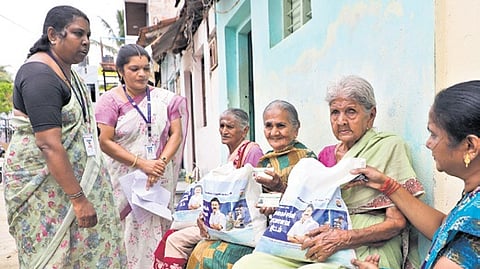

COIMBATORE: Ration shop supervisors are frowning at the allocation of expenses by the cooperative department to distribute rations to beneficiaries under the Thayumanavar Scheme, as the allocated amount, according to them, is not sufficient to deliver the goods. They say they can’t meet the expense of hiring mini-load vans to supply the rations to the elderly and differently-abled cardholders under the scheme. And they have no option than to bear the additional cost incurred for the delivery of essential ration supplies on the doorstep of the targeted beneficiaries.
A supervisor, who did not want to be named, said, “The cooperative department has allocated Rs 36 per card as expenses to the shop to distribute rations to beneficiaries in the urban area. It is fixed at Rs 40 and Rs 100 per card for the rural and hill area. In my shop, 46 cards are classified under the scheme.
Due to connectivity issues in operating Bluetooth-enabled scaling machines, we can reach out to 15-20 cardholders maximum per day. The amount allocated by the department is insufficient to cover our expenses for hiring vans, which amount to Rs 2,000 per day. But the total allocation by the department is just Rs 1,656 (for my shop) to deliver the ration.”
G Rajendran, state president of Tamil Nadu Ration Shop Employees Association, said, “When the scheme was started, the age for the beneficiary was fixed at 70 years, the distribution days were fixed as Saturday and Sunday of the second week. In November, the age was further reduced to 65, and the distribution dates were changed to November 3 and 4.
There is no clarity over the implementation which creates confusion to cardholders and employees. The elderly people in rural areas also don’t have cash when the Net fails.” AM Asiriya Thevan, honorary secretary of Tamil Nadu All Cooperative Bank Employees Association in Madurai, said, “Nearly 50% of the card holders are single individuals residing in remote areas, making it difficult to collect their fingerprints due to poor network connectivity.”
“Many houses do not have lifts. We climb up and down to call beneficiaries. If someone is bedridden, we take the ration inside. After 10–15 households, we are exhausted. Beyond 20, we fall sick the next day,” said a woman worker from North Chennai. However, a senior official clarified, “We call 70 ration cards as one cluster. A worker can easily reach 70 beneficiaries in a day. The department has allocated the amount based on the urban, rural and hill areas.”
(With inputs from D Vincent, Tiruchy; Jeyalakshmi Ramanujam, Madurai; B Anbuselvan, Chennai)
