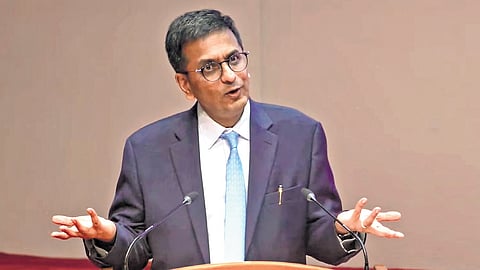

COIMBATORE: The constitutional culture is shaped in places where human vulnerability meets human responsibility, stated Former Chief Justice of India Justice DY Chandrachud while speaking at the 11th Founder's Oration at Ganga Hospital in Coimbatore on Saturday.
While speaking on the theme "Constitutional culture, citizenship, and civic virtue - a moral compass for the nation", he emphasised that doctors do not see themselves merely as providers of care; rather, they view themselves as custodians of public welfare.
"A hospital that restores a patient's mobility or prevents a family from sinking into poverty due to an accident is doing much more than just medical work; it is enabling citizenship. It ensures that a constitutional promise - whether of equality, dignity, or the right to life - is not an abstraction but a lived experience. There is something profoundly constitutional about this ethic of service," he stated.
"None of those in health care take an oath to the Constitution. Yet, they perform actions that uphold constitutional values. Care is a constitutional act. Dignity is its language," he stressed.
Chandrachud described institutions like Ganga Hospital as living examples of constitutional culture, citizenship, and civic virtue. He noted that "constitutional culture is not cultivated only in courtrooms, classrooms, or legislatures. It is shaped in places where human vulnerability meets human responsibility - in emergency wards, ambulances, counselling rooms, and operating theatres, where the constitution, though unnamed, is practised."
He also recalled the health sector's contributions during the COVID-19 pandemic, pointing out that a Constitution becomes real not in grand announcements, but in the small, often unseen places where dignity is either recognised or denied.
"A Constitution survives because a society is willing to confront its own shortcomings, to examine how power is used, how the vulnerable are treated, and how dignity is honoured in the small, unrecorded corners of public life. The Constitution is not sustained by text alone; it must be lived," he added.
Chandrachud stated that the Constitution expects us to meet disagreement with maturity, not suppression. "It's a quiet but powerful lesson that respecting differences is not a matter of convenience, but a measure of our civic culture. Constitutional culture also teaches us self-restraint," he said.
Speaking about citizenship, he remarked that it begins with acknowledging that every individual carries their own sense of self, autonomy, and personal story. He further noted that civic virtue is not merely an individual accomplishment but a collective inheritance.
While commenting about social media he said "We live in a time where information is abundant, but understanding is scarce."
Chandrachud also praised Ganga Hospital's contributions, which extend beyond clinical excellence.
He said Dr S Rajasekaran of Ganga Hospital, a few years back, brought to the Supreme Court's attention India's alarming road safety issues, and the Supreme Court's recent directions address the concerns raised in that petition.
"This partnership between professional insight and constitutional engagement makes institutions like Ganga truly remarkable," he said.