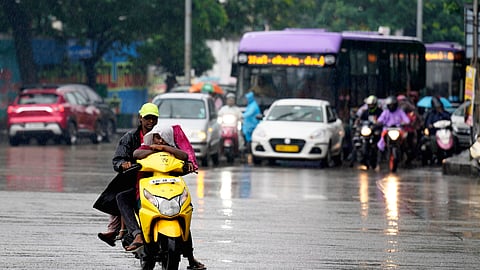

CHENNAI: Tamil Nadu is bracing for several more days of significant rainfall even as the Regional Meteorological Centre (RMC) has withdrawn its earlier indication of a possible cyclone formation over the Bay of Bengal.
In its latest update on Tuesday, the agency did not refer to cyclone development, and instead said that the ongoing weather activity is being driven by two low-pressure systems, both capable of producing widespread heavy rain despite lacking the organisation required for a cyclonic storm.
According to the officials, the well-marked low-pressure area that lay over Malaysia has now strengthened into a depression. Though still far from Indian waters, the system is moving slowly west-northwestwards. Its broad circulation is enhancing cross-equatorial moisture flow and feeding the monsoon surge over southern peninsular India.
IMD said it may intensify further in the next 48 hours, but there are no signs yet of rapid strengthening into a cyclone.
More critical for Tamil Nadu is the new low-pressure area that formed early Tuesday under the influence of an upper-air cyclonic circulation over the Comorin region. It lays over the Southwest Bay of Bengal, south Sri Lanka and the equatorial Indian Ocean. This system is expected to track north-northwestwards, become a well-marked low within 24 hours and a depression by Thursday, pulling moisture and rainbands towards the Tamil Nadu coast.
The removal of the cyclone reference, however, does not translate to mild weather. The IMD has warned of heavy rain across Kanyakumari, Tirunelveli, Thoothukudi and Ramanathapuram over the next two days, before the rain belt shifts towards the Delta and north coastal districts from November 28.
On November 29, several districts — including Chennai, Chengalpattu, Kancheepuram, Tiruvallur, Mayiladuthurai, Cuddalore and the Delta — are likely to receive heavy to very heavy rain, with an orange alert issued for parts of north Tamil Nadu.
South Tamil Nadu once again dominated the rainfall charts in the past 24 hours. Oothu and Nalumukku in Tirunelveli recorded 17 cm each, followed by Kakkachi (14 cm) and Manjolai (13 cm). Several Delta and Cuddalore-region stations registered 5–8 cm, helping further erase monsoon deficits.
