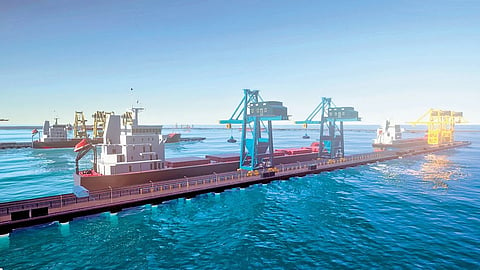

CHENNAI: Researchers at IIT-Madras have developed and deployed a fully indigenous Vessel Traffic Management System (VTMS) for ports, a technology long dominated by foreign vendors.
The system has been built entirely by the IIT’s National Technology Centre for Ports, Waterways and Coasts (NTCPWC) in line with specifications laid out by the Ministry of Ports, Shipping and Waterways (MoSPW), said a statement issued by the institute.
The system, already operational at the Vizhinjam International Seaport Limited (VISL) in Kerala which was inaugurated by Prime Minister Narendra Modi earlier this year, is poised to become a benchmark for coastal infrastructure modernisation.
Two other major ports on the western coast are currently in discussions with IIT Madras to adopt the system. The system will be mainly used for merchant ships, but it can also be used for naval vessels and monitoring small coastal vessels operating in the coastal waters, said a faculty from IIT.
A key strategic advantage of the home-grown solution is the complete control it grants to the central government over the source code, architecture and databases.
Officials said this sovereignty over critical maritime technology not only removes the risk of sensitive vessel-movement data leaking abroad, but also helps the country build a domestic talent pool with both theoretical and hands-on expertise.
K Murali, head of NTCPWC, noted an indigenous system allows India to fast-track innovations and tailor solutions to real-world challenges. “It also reduces financial and operational risks that often arise when dealing with private vendors,” he said.
He further added technologically, the system offers several advantages over imported platforms: customised and OEM-independent radar and voice-data interfacing, an open-source design, and robust security suited even for defence applications. The system is also designed for scalability, capable of being upgraded or replicated across ports with minimal deployment and maintenance cost.
