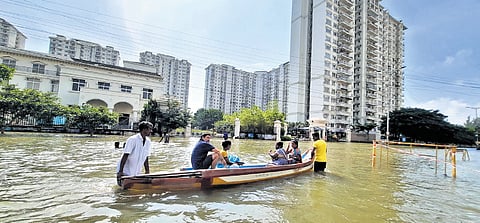

CHENNAI: As the state is bracing for the northeast monsoon, experts have warned that Chennai’s recurring floods are not acts of nature but failures of planning and governance.
At the ‘Tamil Nadu Land Use 2025’ conference organised by the state planning commission, top disaster management officials, scientists, and citizen groups called for urgent reforms in the way land and water are managed, emphasising that unplanned urbanisation and policy silos have turned natural hazards into man-made disasters.
V Thiruppugazh, chairman of the Advisory Committee for Mitigation of Floods in Chennai, set the tone with a blunt assessment. “Disasters are not acts of nature. They are brutal audits of our development choices.”
Drawing from three decades in disaster management, he said every calamity reveals fractures created by human neglect. “In 2019, Chennai was on the brink of ‘Day Zero,’ and yet we saw devastating floods in 2015, 2021, and 2023,” he said.
Thiruppugazh identified three fractures that have deepened Chennai’s vulnerability — unplanned development, fragmented governance, and neglect of the natural character of land and water. “When we ignore the natural character of the land, we pre-register for a future disaster. Water doesn’t encroach during floods, it is simply reclaiming what we stole from it,” he remarked.
While the government is finalising a flood mitigation plan for Chennai, the session spotlighted citizen-led examples of how communities are restoring the city’s lost water resilience. Sunil Jayaram, co-founder of Chitlapakkam Rising, narrated how residents revived the Chitlapakkam lake after decades of neglect.
“The 2015 flood and the 2016 drought were our wake up calls,” he said. Once a garbage dump, the lake was reclaimed through community audits, public mobilisation, and collaboration with the Water Resources Department (WRD).
A case study presented on Sembakkam lake, part of the Pallikaranai marshland cascade, illustrated the magnitude of Chennai’s challenge. The lake receives 8 million litres of sewage daily, lacks a proper drainage network, and sits at the confluence of three municipal boundaries.
Researchers from IIT Madras and The Nature Conservancy found that decades of siltation and unscientific dredging had distorted the lake’s shape, reducing its storage capacity and groundwater recharge potential.
