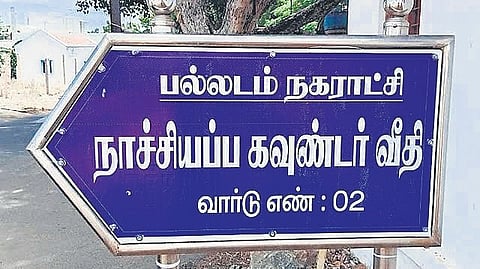

CHENNAI: The state government has issued a set of guidelines for removal of caste-based names from revenue villages and public assets following an assembly announcement by CM M K Stalin in April.
Before making the decision to change the names of villages, roads, streets, bus stands, markets and waterbodies, the existing names are to be analysed by designated authorities after taking into account the opinions of the local communities, according to an official document.
This enumeration is to be done by Block Development Officers (BDOs) and deputy BDOs in village panchayats, and in town panchayats by the executive officers and in other urban local bodies by the municipality or corporation commissioners.
The guidelines also suggest a list of names that may be considered instead – for streets with caste-based names, ‘Kalaignar’, ‘Kamarajar’, ‘Mahatma Gandhi’, ‘Veeramamunivar’, ‘Thanthai Periyar’ were among the suggested alternatives.
In cases where the public assets have caste-based names which are not discriminatory in nature and in cases where the local communities have no objections with the use of these names, it may not be changed, the guidelines say. However, it emphasised that names with cast identifiers such as ‘Adi Dravidar colony’, ‘Harijan colony’, ‘Vannankulam’, and ‘Paraiyar street’ should be avoided.
“This work should be undertaken carefully. It should be ensured that sentiments of the local communities are respected while at the same time, it would be ideal to remove any caste markers,” the document stated.
In revenue villages or other public spaces with such names, the objectionable names and its proposed alternative should be discussed for approval in the area/grama sabhas. If members of the sabhas are of the view to continue with the existing names, the reasons are to be furnished and a decision can be taken accordingly, the document said.
The list of names compiled by the designated authorities is to be further vetted by another set of officials which in the case of change of names to revenue villages, is a committee under the district collector, and in the case of public spaces in village and town panchayats, by an official at the level of assistant director.
Following this, the new names should be notified in the gazette; written objections would be entertained within 21 days of the issue of the notification.
The deadlines for changing the names of public spaces have been set at October 14, October 17 for public consultations (public can also submit petitions for change) and October 23 for publishing the notification in the district gazette.
The department heads are then to forward the recommendations to the state government by November 14 and resolutions are to be passed accordingly at the respective council meetings by November 19 for the new names to come into effect.
In the case of revenue villages, the estimations are to be completed by October 14 which would be followed by public consultations, announcement by the district collector and announcements at the gram/area sabhas by October 17, October 24 and November 19 respectively.
