
COIMBATORE: A former Divisional Engineer of the Road Safety Wing of the State Highways Department has alleged that a powerful lobby is working behind the scenes to sabotage Coimbatore's pioneering signal-free traffic system and reintroduce traffic signals for their own benefit.
G Manuneethi, who served as the Divisional Engineer in the Coimbatore division and retired last August, claimed that a group of influential individuals, with the support of a few government officials, is deliberately trying to make the city's U-turn and roundabout systems appear ineffective. Their alleged motive is to bring back the traffic signal system that was replaced in 2023 after extensive trials.
According to a senior police officer, internal politics and lobbying have intensified in recent months, with certain vested interests attempting to alter the city's traffic pattern for personal or commercial advantage. "There is a huge lobby that wants the U-turns removed and signals restored. They are using political and administrative influence to push their agenda," the officer told TNIE, acknowledging the ongoing tussle.
Coimbatore, one of India's fastest-growing cities, has long struggled with traffic congestion. With the rapid rise of startups, MSMEs, industries, and IT parks, the city's roads have come under immense pressure. Coimbatore's traffic woes had reached levels often compared to Bengaluru's snarls.
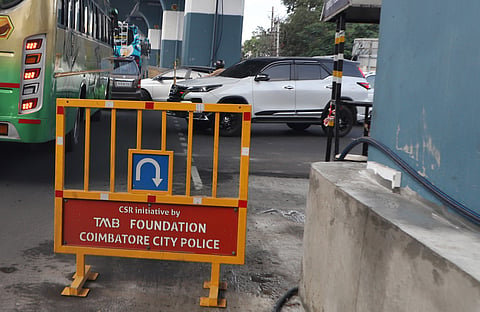
To address this, Manuneethi, in collaboration with the then Deputy Commissioner of Police (Traffic) Mathivanan, initiated the "signal-free roads" project to improve traffic flow and reduce congestion. The idea was simple yet transformative by replacing traditional traffic signals with U-turns and roundabouts, allowing continuous vehicle movement and reducing waiting time at junctions.
The first major trial began in January 2023 at the Lawley Road junction, where signals were switched off and a temporary roundabout was created using sandbags. The result was a visible reduction in congestion. Encouraged by this success, the model was gradually extended to nearly 40 junctions across the city.
The initiative soon drew national attention. Engineers and police officials from other states, including experts from the IIT Madras visited Coimbatore to study the new system, and cities like Chennai and the Thiruvalluvar district later adopted similar models. The success not only brought relief to motorists but also eased the burden on traffic police, who found the system more efficient and less manpower-intensive.
However, the project's growing success appears to have triggered opposition. Speaking to TNIE, Manuneethi said, "A few individuals are trying to make this system fail deliberately. They want to remove U-turns and bring back traffic signals for their own personal gain. With the help of certain officials, they are using all kinds of influence to achieve this."
Sources said some influential businessmen have opposed the system because U-turns were provided near their properties or commercial buildings, which they claim affect access and visibility. In some places, U-turn points were deliberately placed farther from junctions to frustrate motorists and thereby create opposition for the model.
"People's welfare must come above one person's greed," he said, emphasising that dedicated pedestrian signals have been installed where needed to ensure safety without disrupting traffic flow. So far, over 40 signals have been removed and replaced with 13 roundabouts and around 30 U-turn provisions. Despite the challenges, Manuneethi remains hopeful that the system designed to ease traffic and enhance public convenience will endure.
"This model has proven successful. Coimbatore showed the country that smooth traffic without signals is possible. It should not be derailed by those with vested interests," he concluded.
