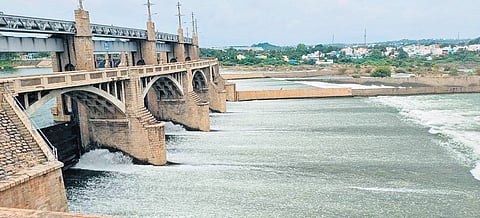

CHENNAI: Though the northeast monsoon has only just begun, albeit with heavy rainfall across many places, major reservoirs in the state are already brimming with water. As many as 16 have been placed under the “red alert” category, with storage levels hovering between 95% and 100% of their full capacity. Officials attribute the high storage to unseasonal rainfall prior to the onset of the monsoon and the state receiving nearly double the expected share of Cauvery water from Karnataka following heavy rainfall there.
According to data from the Water Resources Department (WRD) accessed by TNIE, the combined storage in 90 reservoirs stood at 196.202 tmcft as of Tuesday — 87.46% of the total capacity of 224.343 tmcft. The Stanley Reservoir in Mettur, Tamil Nadu’s largest, has already reached full capacity. The overall storage is significantly higher than the same period last year, when the reservoirs held 143.804 tmcft - just 64.11% of total capacity.
“Steady rainfall over the past few days has increased inflows into major reservoirs. Sixteen, including Mettur, TN Sholayar, and Aliyar, are under red alert as their storage has crossed 95% of the capacity. Three others are on orange alert, with levels between 90% and 95%,” a senior WRD official told TNIE.
The official cautioned residents along riverbanks and low-lying areas to stay vigilant, as reservoir discharge may rise if inflows continue. The department is closely monitoring rainfall patterns and inflow data to ensure proper regulation of water levels. Cauvery inflow has been particularly strong this year. “Karnataka was required to release 133.576 tmcft to Tamil Nadu till October 16, but we’ve received 260.159 tmcft — an excess of 126.583 tmcft,” said another official.
Thanks to this steady inflow, the Mettur dam in Salem, one of the main sources of drinking and irrigation, has touched full capacity seven times this year. The dam’s current storage stands much higher than last year’s 62,140 million cubic feet (mcft), against the dam’s capacity of 93,470 mcft.
Officials expressed confidence that with current levels, the state’s summer drinking water and irrigation needs can be comfortably met. If the monsoon continues at the same pace, the state could witness one of its best water years in recent times.
