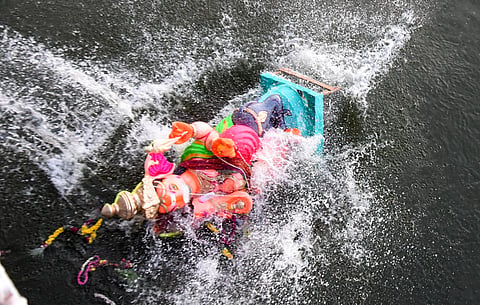

CHENNAI: The southern bench of the National Green Tribunal (NGT) has pulled up the Tamil Nadu government for permitting the immersion of Plaster of Paris (PoP) Vinayagar idols into the sea, in violation of pollution control norms, court orders, and Coastal Regulation Zone (CRZ) rules.
Hearing a plea on the large-scale dumping of construction debris for facilitating idol immersions on a ecologically sensitive coastal stretch in Pattinapakkam in Chennai used by Olive Ridley turtles for nesting, the tribunal said the State had failed to enforce eco-friendly guidelines.
The case was filed by a fishermen leader, K Bharati, who complained that the Greater Chennai Corporation and police facilitated immersion by dumping construction debris on the beach — a CRZ-IA zone — to move cranes for lifting massive idols. "No prior approval was obtained from the Coastal Zone Authority or Pollution Control Board. Even temporary arrangements are not permissible in ecologically sensitive areas," observed the bench, questioning why orders were followed only after the tribunal intervened.
Counsel for the applicant argued that despite a clear government order from 2018 mandating clay-only idols painted with natural, water-soluble colours, hundreds of PoP idols coated with toxic paints were immersed. "The State cannot turn a blind eye at the manufacturing, sale, and transport stages and then plead helplessness during immersion. The State has made a mockery of the court orders," counsel said, citing rampant non-compliance.
The counsel for the Tamil Nadu State Coastal Zone Management Authority and State Pollution Control Board admitted that full compliance had not been achieved, though awareness campaigns were conducted. He pointed to "flying squads" and police reporting formats that attempted to track materials used in idols. "We have taken several steps and launched crackdown on illegal idol manufacturers across the State, still not able to achieve full compliance," the counsel said.
But, it was quite evident, the majority of idols immersed at Pattinapakkam on Sunday were made of PoP. On removal of debris and restoration of the beach, the counsel for the Greater Chennai Corporation told the tribunal that 55 lorry loads of debris had been cleared from Pattinapakkam. He insisted that the administration was "balancing law and order concerns with environmental protection."
The State submitted that the government had issued directions through a Section 5 order of the Environment Protection Act, but "facilitating peaceful celebrations" was also a priority. He accepted that the Madurai Bench of the High Court had recently ordered Pollution Control Board certification before immersions, calling it a "welcome measure" that would be considered for state-wide adoption during next year's celebrations.
The tribunal, however, was not convinced. It observed that public order concerns could not justify environmental violations and that authorities should have acted months in advance to regulate idol making, sales, and immersion points. It suggested Tamil Nadu emulate practices in Maharashtra and Pondicherry, where idols are segregated, alternative immersion tanks are provided, and puja waste is collected separately.
"Why should the government allow banned idols to enter the immersion sites at all?" judicial member Justice Pushpa Satyanarayana asked, stressing that compliance cannot be reduced to post-event cleanups. The matter has been posted for further monitoring of compliance on September 19.
