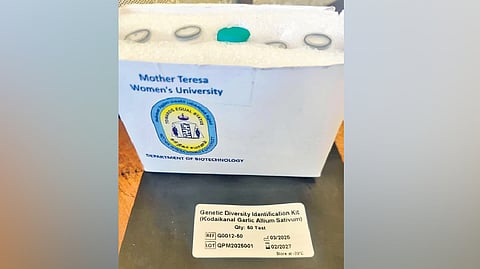

CHENNAI: Mother Teresa Women’s University has developed an advanced PCR-based detection kit to ensure the authenticity of Kodaikanal malai poondu (Kodaikanal hill garlic), a unique variety of garlic that holds a Geographical Indication (GI) tag.
The surge in demand for the Kodaikanal hill garlic has also led to the adulteration of the product, where inferior varieties are falsely sold under its name. This not only misleads consumers but also causes significant economic losses for genuine farmers.
To address this issue, the university’s biotechnology department researchers have developed a Real-Time Polymerase Chain Reaction (RT-PCR) kit that scientifically verifies the genetic authenticity of Kodaikanal hill garlic. This kit is particularly beneficial for exporters who require precise and credible authentication before sending the garlic to national and international markets.
“The PCR kit functions by detecting the expression of the ALI gene, a genetic marker found to be significantly more expressed in GI-tagged Kodaikanal hill garlic than in other varieties,” said A Usha Raja Nanthini, professor who has developed the PCR kit.
She further explained that using RT-PCR technology, specific primers target this gene for amplification. The presence of the ALI gene is confirmed through the cycle threshold (Ct) value; authentic samples exhibit a particular Ct value, while non-authentic samples either fail to amplify or display different Ct values. This enables accurate identification of genuine Kodaikanal hill garlic at the molecular level.
Varsity officials said there was demand for such equipment from the exporters. “The exporters are currently using the kit available in the university. We have applied for patent for this kit,” said Nanthini.
The university has conducted low-pass whole-genome sequencing to identify distinct genetic markers that differentiate this variety from non-GI garlic varieties.
“We have submitted the sequencing data obtained to the Sequence Read Archive to ensure transparency and scientific validation,” said Nanthini.The PCR kit complements the already available sulfur-based colour kit used by farmers, offering a dual-layered defence against adulteration and reinforcing the credibility of Kodaikanal’s cherished hill garlic
“After GI tag allocation, the demand for malai poondu has increased significantly, and our innovation ensures that only authentic GI-tagged garlic enters the supply chain, thereby protecting farmers’ livelihoods and maintaining the product’s reputation in the global market, “said S Vincent, member secretary of Tamil Nadu Council for Science and Technology. The council was an applicant for garlic variety GI tag.
Market flooded with adulterated variety
Known for its rich aroma, strong pungency, and medicinal properties, this hill garlic has gained high market value in recent years. However, the surge in demand has also led to the adulteration of the product, where inferior varieties are falsely sold under its name
