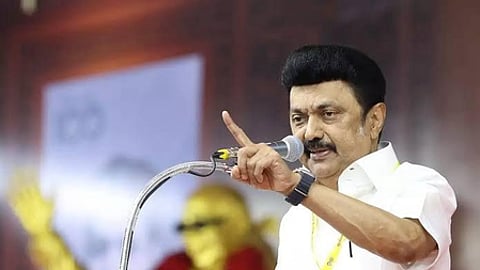

CHENNAI: Chief Minister M K Stalin has urged Prime Minister Narendra Modi to immediately withdraw the recent Office Memorandum (OM), issued by the Union Ministry of Environment, Forest and Climate Change (MoEFCC), which exempts the requirement of public consultation for mining projects involving atomic and strategic minerals notified in the Mines and Minerals (Development and Regulation) Act.
The CM has also pointed out that the OM directs that from now on, all such projects need to be exclusively appraised at the central level, irrespective of the lease area.
“The present OM, by dispensing with public consultations, has gone for an impermissible executive amendment of a statute and is unsustainable,” he said. Stalin warned that dispensing with such consultations would deprive the coastal communities of their right to raise concerns over livelihood, displacement and ecological damage due to mining and weaken the overall democratic process.
CM raises legal objections to centre’s mining norms citing SC, NGT rulings
Stalin pointed out that Tamil Nadu’s coastal districts are endowed with rare earth deposits, but they are also among the most ecologically fragile regions. The sandy beaches along the Gulf of Mannar and Palk Bay, he said, are critical habitats for endangered turtles, coral reefs, mangroves and sand dunes, and act as natural barriers against erosion and cyclones. “Mining in such regions is inherently eco-sensitive and demands rigorous scrutiny with the fullest involvement of local communities,” he said.
As per Tamil Nadu’s Department of Geology and Mining, the beach sand minerals in the state contain titanium bearing minerals under the new OM like ilmenite, rutile, leucoxene in districts like Thoothukudi, Kanniyakumari, Tirunelveli, Ramanathapuram, Pudukkottai, Tiruchy, Thanjavur, Nagapattinam, Tiruvarur, Cuddalore and Kancheepuram districts.
A proposal to allow mining of tungsten in Arittapatti in Madurai was rescinded, following widespread opposition.
Stalin, in his letter, also raised legal objections, citing Supreme Court and National Green Tribunal rulings, which had held that substantive changes to the EIA framework cannot be made through executive instructions like OMs.
“The Hon’ble National Green Tribunal has in the past struck down Office Memorandums which sought to dilute statutory safeguards. Further, the Hon’ble Supreme Court, in Alembic Pharmaceuticals Ltd vs Rohit Prajapati & Ors. (2020), has held that substantive amendments to the EIA framework cannot be brought about by way of executive instructions such as OMs, and that such instruments cannot override statutory notifications,” he said.
Asserting that policy changes of such significance must be discussed transparently, he added that bypassing these processes would run counter to the spirit of cooperative federalism and to the democratic ethos of the country. He also said he wanted to take the opportunity to reiterate the state’s “commitment to contributing to the nation’s strategic and defence requirements, as has always been done in the past”.
