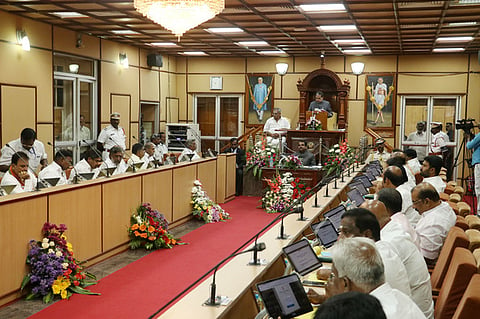

PUDUCHERRY: The Union Territory of Puducherry has passed four significant bills in the Legislative Assembly, aimed at transforming Puducherry into one of the most competitive and preferred destinations for investments.
The Puducherry Ease of Doing Business Bill, 2025, Amendments to the Town and Country Planning Act, Puducherry Municipalities Act, and the Commune Panchayat Act, along with a series of notifications and amendments, are focused on reducing compliance burdens, simplifying licensing processes, and strengthening urban governance.
The Puducherry Ease of Doing Business Bill sets clear timelines for each stage of approval, introduces provisions for deemed approvals, and prescribes penalties for delays. The move is designed to ensure faster clearances for industries, businesses, and commercial establishments. Complementing this, amendments to the Municipalities and Commune Panchayat Acts provide that trade licenses issued by local bodies will now be valid for five years, while doing away with the requirement for physical inspections.
The amendment to the Town and Country Planning Act simplifies the cumbersome procedure for change in land use, while incorporating provisions for premium Floor Area Ratio (FAR), Transferable Development Rights, and land pooling. Building bye-laws have also been revised to give entrepreneurs instant online access to permitted land-use categories and other details. Micro, Small and Medium Enterprises (MSMEs) can now be set up in residential, commercial, and agricultural zones without requiring change-of-land-use approvals, while residential facilities for industrial workers are permitted within industrial estates.
Further reforms include easing the minimum road-width requirement for setting up industries from 5 metres to 4.5 metres, revising FAR and height limits to allow flexible use of land, and the development of an industrial parks database by PIPDIC to enable investors to search available plots along with infrastructure details. An online building permission system is also being introduced, under which occupancy certificates will not be required for smaller residential, commercial, and industrial buildings.
Labour reforms have also been rolled out, allowing night-time employment of women in factories, shops, and commercial establishments. Shops employing fewer than 50 people have been exempted from the Puducherry Shops and Establishments Act, 1964.
Environmental norms have been relaxed with “white category” industries—expanded from 36 to 752 units—exempted from seeking consent to establish or operate. Fire safety norms have also been simplified, with NOCs now valid for three years and issued based on third-party inspections and self-certification. Under the new system, occupancy certificate(s) will not be required for residential building(s) with up to six dwelling units, commercial building(s) with a floor area of up to 500 square meters, or for any industrial building(s).
Officials noted that Puducherry’s reforms, particularly its building bye-laws and negative list provisions, have been recognized as a national best practice. Alongside new online systems for electricity and water connections, the government said the measures will transform Puducherry into one of India’s most competitive investment destinations.
