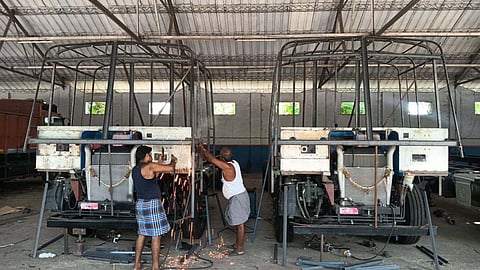

NAMAKKAL: Namakkal, once celebrated as the lorry body-building capital of South India, is witnessing a sharp slowdown in its core industry. Rising fuel prices, toll charges, and soaring material and electricity costs have forced lorry owners to look elsewhere, eroding the district's dominance in a trade that has supported thousands for decades.
At its peak, Namakkal and neighbouring Thiruchengode boasted nearly 120 lorry and other bodybuilding units that together turned out around 1,500 lorries a month. Today, output has fallen to just 500, and many small workshops are surviving on a single order a month. Only two or three units qualify as large-scale industries, the rest are struggling small businesses that often work on wafer-thin margins.
The ripple effects are severe. More than two lakh people were once employed directly or indirectly in the sector, but about 30% of the workforce has already shifted to other jobs.
Skilled craftsmen, some with over 20 years of experience, are now moving on contract basis to Kerala, Karnataka, and Andhra Pradesh, where lorry bodybuilding has picked up as operators prefer to avoid Tamil Nadu's tolls and higher diesel costs. This shift has redistributed an industry that was once firmly concentrated in Namakkal.
"The situation has become unsustainable. Our electricity bill that was once Rs 12,000 now touches Rs 28,000," said P Thiyagarajan, owner of Shree Gowriamman Industries, one of the largest lorry-body fabricators in the region. "From 20 orders earlier, I now get only five in a month. Business has come down to 40%."
Adding to the pressure is the introduction of BS6 emission norms, which require all trucks to have cleaner, less polluting engines which are considered costly to be built and maintained. While Thiyagarajan acknowledges that the rules are necessary to reduce pollution, he says they have dampened demand at a time when the industry is already struggling.
Costs of steel and other raw materials have also skyrocketed, pushing up manufacturing expenses and squeezing small units that cannot keep pace with rising electricity bills and rent. The overall rise in manufacturing cost has hit smaller workshops the hardest, leaving them unable to compete with bigger players.
Namakkal's bodybuilders, who fabricate over 15 types of trucks, tankers, and trailers with load capacities of up to 39 tonnes, are now appealing for relief. They want the central government to recognise the crisis, conduct a detailed survey of the sector, and bring out welfare schemes for the workforce.
"Just as handloom weavers receive concessions, we too should get support, even free power for small units," said Thiyagarajan.
Industry insiders say urgent government intervention and targeted welfare measures are essential to prevent the sector and the livelihoods it supports from sliding further.
