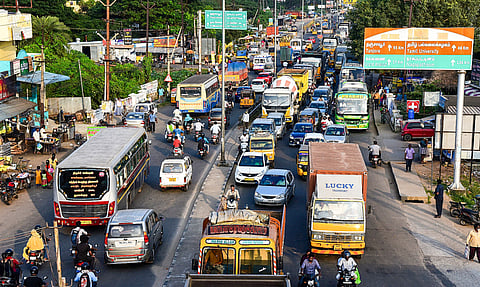

CHENNAI: The state is reviewing the Ministry of Road Transport and Highways’ draft policy on decongesting national highways in urban clusters, including a proposal to de-notify stretches passing through city cores and transfer them to state or local bodies.
The policy aims to ease congestion in and around urban agglomerations through the development of ring roads and bypasses, while linking highway expansion with planned urban growth and industrial corridors. It also calls for integrating NH alignments with city and town master plans. The centre has outlined five participation models for states, though their applicability in Tamil Nadu varies.
As per the cost-sharing model, the state is allowed to fund 50% of project costs in return for an equivalent share of toll revenues over 15 years. While administratively simple, this option is fiscally demanding, said official sources. The next option, which sources said was a more viable near-term route, is one under which the state would bear around half the acquisition cost, typically 30-50% of the total project outlay in urban stretches. Tamil Nadu’s established processes make this model easier to operationalise, sources added.
Another option combines partial land cost sharing with reimbursement of the state’s share of GST and mineral royalties. Here, the state would bear 25% of land costs while refunding levies embedded in construction costs, with GST alone contributing an estimated 10-13% of project expenditure. By contrast, the other land pooling model option, under which landowners contribute land in exchange for development rights, remains largely untested in the state and lacks institutional backing.
Similarly, the VCF approach, which seeks to monetise land value gains through levies such as development charges or betterment fees, has no clear legal basis, said official sources. Under the framework, such proceeds will be shared with the centre over 15 years, capped at 50% of project cost on a net present value basis.
KP Subramanian, former professor of urban engineering at Anna University noted TN had experimented with value capture through betterment levies under the Madras Town Planning Act, 1920, but the mechanism failed to yield meaningful revenues despite similar provisions being retained subsequently.
As a result, the state’s participation is likely to remain confined to conventional funding routes, potentially constraining the pace and scale of urban highway decongestion.
The draft policy seeks to ease highway congestion by separating long-distance traffic from local movement through bypasses, ring roads and elevated corridors.
