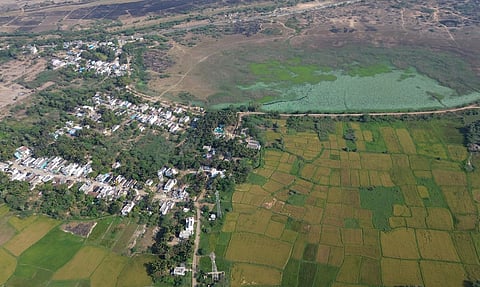

CHENNAI: There is an uneasy calm in Nelvoy. Villagers eye strangers with suspicion, conversations are guarded and many are reluctant to speak — a reflection of the uncertainty that has settled over the villages after the Tamilaga Vettri Kazhagam government scrapped the proposed Parandur airport project.
Nelvoy is among the roughly 13 villages in the Kancheepuram district where nearly 5,746 acres of land was originally slated for acquisition.
The government has cancelled the airport project, but Industries Minister S Keerthana told the Assembly recently that the 1,802 acres of acquired land could be used for setting up eco-friendly industries to create jobs. While opposition parties and ally CPM want the TVK government to return the land to farmers, there is no official response from the government yet.
The decision has left people in a predicament: Farmers who sold their land are wondering what will become of the compensation they received, investors face plummeting or unpredictable land values, and remaining agrarian families worry about the future of their farms.
For 74-year-old K Sigamani of Nelvoy, the uncertainty is painfully personal.
Sigamani had surrendered 45 cents of land for Rs 30 lakh. His hands trembled and his lips quivered as he struggled to hold back tears. “I sold the land. My son told me to do so. I have exhausted the entire money,” he said, his wife sitting beside him, seemingly unsure why he was speaking to strangers. “The government’s decision should not put my husband in trouble,” she says.

Her worry is shared by several villagers who declined to speak on record. Their immediate question is what happens to the compensation already paid if the airport is no longer being built. Will the government seek the money back?
In neighbouring Mel Eri, Seeralan had given up five acres for the airport project. He said villagers were effectively left with little choice as the government pursued its plan for Chennai’s second airport. “We were told either to take compensation worth 3.5 times the market value or collect it from the court if we opposed. If we went to court, the compensation would be only 2.5 times,” he said.
He eventually received about Rs 3 crore and invested the money in three plots in Sunguvarchatram. “I still have a few cents of land left and a house in Mel Eri village,” he said. Villagers sitting under a tree to escape the blistering heat joked about his sudden windfall, as Seeralan defended his decision to sell.
Of the 5,746 acres earmarked for acquisition for the airport, 2,682.62 acres are classified as wetlands, including agricultural land and waterbodies. So far, 1,802 acres have been acquired. No land in Ekanapuram and Thandalam was acquired due to stiff resistance from the villagers.
Nearby villagers are ruing that their land parcels have been acquired while those of Thandalam and Ekanapuram, who resisted the acquisition, remained with them. “We are not that fortunate,” Sigamani said, referring to the lack of unity among villagers in Nelvoy.
“Officials forced us to sell the land, threatening that we would be taken to court and the compensation deposited there. Who would want to go to court?” he said softly, as his grandson looked on. There is a simmering anger in him. His land, though acquired by the state, continues to be irrigated by Dalits in the region, highlighting the divide among the title holders and the farm workers in the village.
The proposed airport had triggered a sharp rise in local land prices. Parcels that once sold for about Rs 250 a cent were fetching nearly Rs 2,500, with some touching Rs 3,000, according to Barnabas, a local land broker.
But the airport project had not been the only force that reshaped the land market. The government had notified a SIPCOT industrial park nearby before the polls, further pushing up expectations over land values. A cent was being quoted at around Rs 1.03 lakh before the project got scrapped, Seeralan said. “I should have got at least Rs 1 lakh per cent,” he said, accusing the government of having cheated landowners. Yet, with the airport now scrapped, he also believes the original sale may ultimately prove to have been a lucrative bargain.
That is because the land boom has now gone into reverse. Since Chief Minister C Joseph Vijay announced the cancellation of the airport project, villagers say land prices have taken a nosedive, with some parcels now being quoted at around Rs 1,000 a cent.
The uncertainty facing the farmers is also compounded by a more fundamental question: who will farm the land that remains?
Kumar, a local farmer, said younger people are increasingly reluctant to continue in agriculture. His son Raghul, a Class 10 student who famously questioned TVK leader Vijay as to why he has not visited their village during the airport protest, has no plans to take up his dad’s profession. Inspired by the actor, Raghul wants to be a politician. Now that the airport project is officially scrapped, he wants to meet the CM to thank him.
There is also a visible generation gap in the villages. Many youngsters wanted to pursue careers in nearby Chennai rather than spending lives tilling the fields. “Children want flashy bikes. They want to work in cities. They do not want to work in the fields,” Kumar said.
The shift is part of a broader trend in Tamil Nadu. The state has lost 1.617 million hectares of net sown area over four-and-a-half decades, while the share of net sown land in its geographical area has declined from 48% to 36%, according to a State Planning Commission-funded study. Land under non-agricultural uses rose from 1,501.6 thousand hectares in 1971 to 2,200 thousand hectares in 2015-16, pointing to sustained diversion of agricultural land.
The airport may no longer be coming in Parandur. But the consequences of the project — and its sudden disappearance — are likely to remain embedded in the land and livelihoods of these villages for years to come.