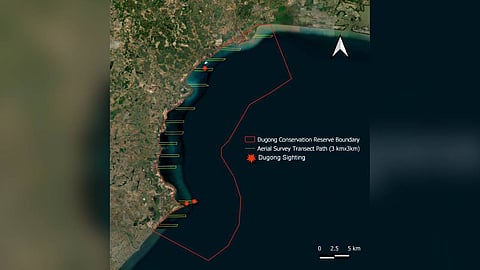

CHENNAI: A comprehensive population assessment conducted by the Wildlife Institute of India (WII) in collaboration with the Tamil Nadu Forest Department has estimated a total of 270 dugongs along the State’s coastline.
The assessment indicates that the globally vulnerable marine mammal population in Tamil Nadu is stable and showing signs of recovery.
According to the assessment, 158 dugongs were recorded in Palk Bay, while 112 individuals were estimated in the Gulf of Mannar, two regions that together form the species’ last stronghold in India.
Dugongs, also known as sea cows, are highly dependent on seagrass meadows and are considered indicators of healthy coastal ecosystems.
“This is the most robust and scientifically rigorous estimate of dugongs in Tamil Nadu so far, the results show that sustained protection, habitat conservation and community engagement are beginning to yield positive outcomes", said Supriya Sahu, Additional Chief Secretary to TNIE.
The assessment adopted a novel drone-based methodology, marking a shift from earlier reliance on fisher interviews and opportunistic sightings.
High-resolution drones equipped with optical cameras were deployed to scan shallow coastal waters where dugongs forage systematically.
Surveys were conducted during optimal sea and light conditions to maximise detection probability.
To avoid double counting of animals moving between regions, the team carried out synchronised population estimation across Palk Bay and the Gulf of Mannar.
Trained forest staff, researchers and local stakeholders participated in coordinated surveys, ensuring uniform data collection protocols.
“Dugongs surface briefly to breathe, making them difficult to detect. Drones allowed us to capture repeated surfacing events and validate sightings with imagery. If not for technology, only 28 sightings were recorded from 2017 to 2025,” said WII scientist JA Johnson, who presented the study findings during the annual research conference at Advanced Institute for Wildlife Conservation (AIWC).
Johnson also told TNIE that the team was using machine learning techniques to increase the probability and accuracy of future assessments.
Officials attribute the encouraging numbers to over a decade of targeted conservation interventions in Tamil Nadu, including the establishment of the Dugong Conservation Reserve in Palk Bay, restrictions on destructive fishing practices, and sustained awareness programmes among coastal fishing communities.
“The stability of the dugong population reflects the success of our conservation strategy,” said Chief Wildlife Warden Rakesh Kumar Dogra.
“Community participation, especially in Palk Bay, has been crucial. Fishers are increasingly reporting sightings instead of viewing dugongs as accidental catches,” he said.
The report notes that while the population remains small and vulnerable to threats such as boat strikes, entanglement and habitat degradation, the current trend offers hope for long-term recovery if protection measures continue.
