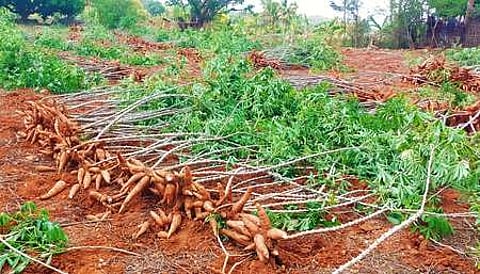

SALEM: Tapioca farmers in the district have intensified their demand for a minimum support price (MSP) for the crop, citing severe price fluctuations and rates that have fallen far below production costs, leaving cultivators in financial distress and uncertainty.
Farmers said tapioca prices, which are largely fixed based on starch content, have dropped sharply this season despite favourable growing conditions. Currently, tapioca is sold at Rs 5 per kg, translating to barely Rs 375 for a 75-kg sack, compared to over Rs 1,000 per sack in previous years. On a per-tonne basis, prices have declined to below Rs 5,000, making cultivation economically unviable for most small and marginal farmers.
S Jayaraman, a tapioca farmer and president of Salem District Farmers Club Federation, said the price crash had occurred despite good starch yield and stable output. "Last year, there were periods when prices crossed Rs 10,000 per tonne. Now, even with good starch content, prices have fallen below Rs 5,000. Mill owners determine the rates and farmers have no role in price fixation," he said.
He pointed out that tapioca, being a highly perishable crop, cannot be stored for long. "Farmers are forced to sell immediately after harvest at prices fixed by mills. Mill owners buy in bulk during the harvest season, convert the produce into starch and other by-products, and sell them later at a substantial profit," he said, adding that an MSP was essential to ensure fair and assured returns to cultivators.
Echoing this, VS Govindaraj, president of Salem District Farmers Welfare Association, said the lack of price stability had made farming risky. "Farmers continue to raise demands year after year, but no concrete action has followed. Since prices keep fluctuating, there is always uncertainty. A MSP will bring stability to a crop that is cultivated extensively in the district," he said.
Salem remains one of Tamil Nadu's major tapioca-producing regions, largely due to its favourable soil composition and climatic conditions that support high starch content. Tapioca cultivation provides livelihood to thousands of farming families in the region. However, farmers said the persistent fall in prices was discouraging cultivation and forcing many to reconsider crop choices.
Referring to policy commitments, farmers recalled that the announcement of MSP for tapioca had been promised during the 2021 Assembly elections, but alleged that no concrete steps had been taken yet to implement it.
The role of Sagoserve, the cooperative established to support tapioca growers through procurement and processing, has also drawn flak from farmers. They alleged that despite the cooperative's presence, their long-standing issues remain unresolved. Responding to this, Sagoserve Managing Director R Keerthy Priyadarshini said the cooperative was not directly involved in fixing the price of raw tapioca. "Mill owners have an association and they decide the price," she added.
Farmers said a committee has been formed with District Collector R Brindha Devi as president and Sagoserve managing director as vice president, with officials from the agriculture and horticulture departments, mill owners, traders, and farmers as members. Meetings of the committee are being conducted and growers said they were hopeful that the discussions would lead to a decision beneficial to farmers.
However, farmers alleged that mill owners function as a syndicate and continue to keep prices artificially low. "Unless an MSP is fixed, tapioca farmers will remain vulnerable to losses year after year," they said.
