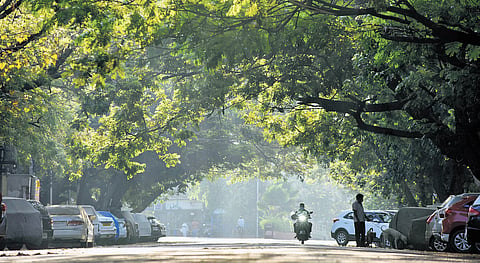

CHENNAI: The Tamil Nadu government on Friday unveiled its first-ever Urban Greening Policy, 2026, laying out a framework to integrate trees, urban forests, parks, wetlands and blue-green infrastructure into city planning.
The policy, released by Chief Minister MK Stalin, mandates that Urban Local Bodies (ULBs) across the state strive to maintain at least 15% of their total municipal area under green cover, while prioritising native and climate-resilient tree species and equitable access to green spaces. According to the government, the policy responds to mounting challenges posed by rapid urbanisation, urban heat island effects, declining air quality and shrinking open spaces. TN’s urban population is projected to touch nearly 67% by 2031, increasing pressure on ecological systems in cities.
“The Urban Greening Policy provides a comprehensive and forward-looking framework to mainstream nature into urban development,” the government said in an official statement, adding that it aligns with the state’s Climate Change Vision and Sustainable Development Goal 11 on sustainable cities.
A key feature of the policy is the proposal to establish a state-level Urban Greening Coordination Committee, chaired by the Chief Secretary, to ensure convergence among departments such as Municipal Administration, Environment, Housing, Public Works and Horticulture. The Municipal Administration and Water Supply department will also set up a dedicated urban forest wing to plan and implement greening initiatives in urban areas.
Supriya Sahu, Additional Chief Secretary, Environment, Climate Change and Forests Department, said the policy marked a shift from plantation-driven targets to outcome-based urban ecology.
“Our focus is on building long-term green infrastructure that cools cities, manages floods, improves air quality and enhances biodiversity, rather than just counting saplings,” she said.
The policy encourages cities to adopt global benchmarks such as the 3-30-300 Urban Green Liveability Guideline, which promotes visibility of trees from homes, neighbourhood-level canopy cover and walkable access to public green spaces. ULBs are also encouraged to improve city biodiversity index scorecards, also known as the Singapore Index, to track ecological health.
Funding for urban greening will be mobilised through convergence of existing schemes such as AMRUT, Smart Cities Mission and the Green Tamil Nadu Mission. Urban local bodies may also explore levying a green fee linked to building permissions and development approvals, the policy states.
“Urban greening is not just about aesthetics; it is a public health and climate adaptation imperative,” said I Anwardeen, Principal Chief Conservator of Forests and Chief Mission Director, Green Tamil Nadu Mission. “By integrating trees and water systems into city planning, we can significantly reduce heat stress and flood risks.”