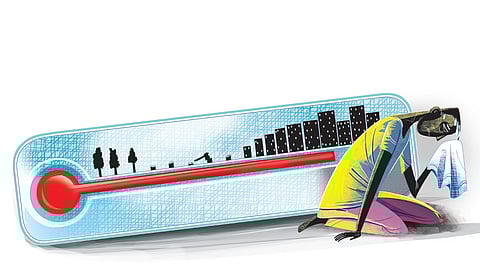

CHENNAI: Tamil Nadu’s major cities are witnessing intensifying urban heat stress, with Chennai emerging as a key hotspot in new ward-level mapping that identifies landfills, industrial clusters and low-income settlements as the most vulnerable zones.
The findings come from the report ‘Urban Heat Island Assessment and Strategic Guidelines for Urban Cooling in Tamil Nadu’ released during Tamil Nadu Climate Summit 4.0, which introduces a first-of-its-kind Heat Risk Index for Chennai, Coimbatore, Tirunelveli and Tiruchy.
The study warns that thermal discomfort days in the state could exceed 200-250 days annually by 2050, signalling prolonged heat exposure for urban populations. Chennai has already seen its mean land surface temperature rise from 29.40C in 2000 to 33.60C in 2020, highlighting the accelerating warming trend.
“Tamil Nadu has been a frontrunner in heat mitigation, becoming the first Indian state to formally notify heatwaves as a state-specific disaster and among the first to establish a dedicated Heat Resilience Center,” said additional chief secretary (environment, climate change and forests) Supriya Sahu.
The ward-level analysis shows a strong link between built-up density and rising temperatures. In Chennai Corporation, 81% of land is built-up, while forests account for only 2%, limiting natural cooling potential.
Researchers found high heat zones consistently clustered around dump yards, such as Kodungaiyur and Perungudi in Chennai, the Vellalore compost yard in Coimbatore, and Ariyamangalam in Tiruchy, due to sparse vegetation and dense impervious surfaces.
Industrial belts, including Ambattur in Chennai and Rathinapuri in Coimbatore, also emerged as thermal hotspots.
The report highlights pronounced “green inequity.” Low-income coastal neighbourhoods such as Nochikuppam and Ayothikuppam in Chennai recorded very low NDVI values (0-0.1) and extremely high UHI intensity, with fewer than one park per sq km.
ICLEI South Asia executive director Emani Kumar told TNIE the ward-level framework enables targeted action. The study, he noted, “provides actionable recommendations to mainstream cooling into climate planning, infrastructure development and governance systems,” helping cities prioritise greening, heat-resilient infrastructure and public amenities.