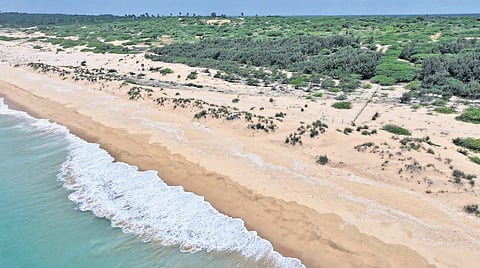

CHENNAI: A multi-layered coastal bio-shield is coming up along the erosion-prone Kulasekarapattinam coast in Thoothukudi to protect vulnerable shorelines near the under-construction second spaceport of the Indian Space Research Organisation (Isro). The intervention aims to arrest shoreline retreat while strengthening climate resilience around the strategic facility.
The bio-shield will be developed as a multi-zoned green buffer in an area of about 50 hectares south of the spaceport, combining sand dune stabilisation with layered native vegetation. The project forms part of a broader climate adaptation strategy being developed under the Tamil Nadu Climate Change Mission with technical inputs from the National Centre for Coastal Research, National Centre for Sustainable Coastal Management, INCOIS, MSSRF and Anna University.
According to the concept plan presented at the Tamil Nadu Climate Summit 4.0, dune-binding species such as Ipomoea biloba and Spinifex littoreus will stabilise the seaward edge. Behind this, multiple plantation rows of hardy coastal species — including casuarina, palmyra, pandanus, neem, pongamia and Thespesia populnea — will form successive protective bands.
The bio-shield will maintain a safe buffer from the high tide line to avoid disturbing natural sediment movement. The plantation is being designed in five ecological zones, moving from dune grasses to dense tree belts and finally broad-leaved coastal species inland. Supriya Sahu, additional chief secretary, Environment, Forests and Climate Change, told TNIE that the design mimics natural coastal ecosystems and is intended to reduce wave energy, trap moving sand, minimise wind erosion and create a living storm buffer.
Isro is developing the Kulasekarapattinam site primarily for launching Small Satellite Launch Vehicle (SSLV), meant for quick and low-cost commercial missions. Unlike Sriharikota, launches from Thoothukudi can fly directly south over the Indian Ocean, improving fuel efficiency and payload capacity. However, the coastal stretch has shown increasing vulnerability in recent years, making nature-based protection measures a priority.
Scientists note that hard engineering structures alone may not provide long-term resilience in dynamic sandy coasts. Thoothukudi DFO M Ilayaraja said post-tsunami studies revealed that mono-row casuarina plantations failed in several locations, prompting a shift to dense, multi-species belts.
“Research indicates that planting at least 30 trees per 100 square metres across a minimum 100-metre width can significantly withstand wave impact. In our design, casuarina planted at 2x2 metre spacing gives nearly 50 trees per 100 sqm, denser than the benchmark.”
He said that recent studies suggest such dense, layered bio-shields could reduce tsunami impact by up to 90% when properly designed and maintained.
