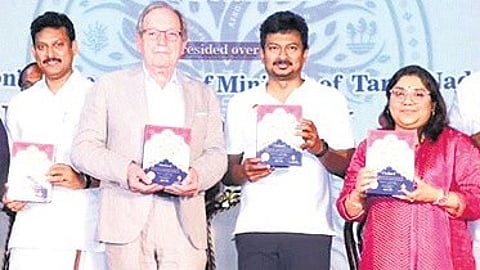

CHENNAI: Deputy Chief Minister Udhayanidhi Stalin on Saturday released the fourth volume of the Comparative Etymological Dictionary Project of Tamil and Indo-European Languages, a joint initiative of the Tamil Nadu Textbook and Educational Services Corporation (TNTB&ESC) and Oxford University Press, on the occasion of World Mother Tongue Day.
The four-year project, launched in July 2022, aims to study the etymological relationship between Tamil and Indo-European languages. A total of 12 volumes are planned at a project cost of Rs 8 crore. In March 2025, Chief Minister M K Stalin released the general introduction volume and the first volume of the project, while the second and third volumes were released at the Chennai International Book Fair held in January.
The project team, headed by chief editor K Arasendran, holds that around 300 of the 461 Indo-European roots identified by English etymologist Walter Skeat have links with Tamil. Based on this research, TNTB&ESC signed an agreement with Oxford University Press in January 2025 to publish the findings in 12 volumes. The fourth volume documents – based on hypotheses – links between 19 Tamil roots and words in Indo-European languages. Following the book release, seminar sessions were held with the participation of international linguists.
Speaking at the event, Udhayanidhi recalled that apart from being observed as World Mother Tongue Day, February 21 also marks the day in 1940 when Hindi was withdrawn from schools in Tamil Nadu following protests led by Periyar E V Ramasamy.
Responding to those who questioned why Tamil Nadu refuses to accept Hindi unlike other states, he said Tamil has the ability to function independently without the support of other languages, citing scholars such as Robert Caldwell and Devaneya Pavanar.
“Many ask what the Dravidian movement has done for Tamil. My response is this: it was DMK that ensured Tamil Nadu would always follow the two-language policy. It was the DMK government that firmly declared there is no place for Hindi here. It was DMK that renamed the state as Tamil Nadu,” he said.
