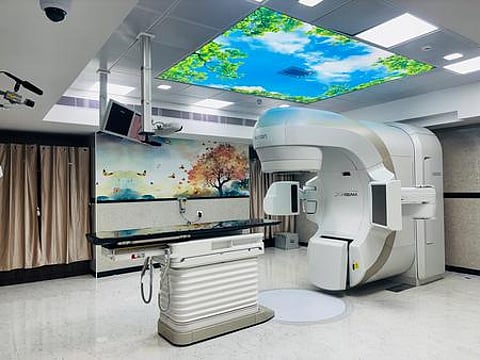

SALEM: The Government Mohan Kumaramangalam Medical College Hospital (GMKMCH) in Salem has achieved self-sufficiency in the field of radiation oncology after the procurement of advanced cancer treatment equipment in June 2025, with zero referrals to other medical college hospitals and a sharp rise in the number of patients treated.
The hospital installed a Linear Accelerator (LINAC) at a cost of Rs 22.96 crore, a brachytherapy unit imported from Germany at Rs 4 crore, and a CT simulator at Rs 4 crore. A separate building for the radiation block was constructed at a cost of Rs 3 crore to house the equipment.
A senior professor in the oncology department said that earlier, the hospital relied on a digital telecobalt machine for radiation therapy, which had limitations in precision. "When we were using the telecobalt machine, radiation rays would pass through nearby healthy areas as exact targeting was difficult. After the introduction of LINAC, we can achieve better precision," the professor said.
The impact of the upgrade has also reflected in patient numbers. When the telecobalt machine was in use, around 500 patients were treated in a year. Since the commissioning of the high-end advanced equipment in June 2025, about 487 patients have been treated in just six months.
The LINAC is used to deliver external radiation therapy and enables doctors to focus radiation more accurately on tumours, reducing damage to surrounding tissues. With the new machine, the hospital has begun treating complex cases such as brain and lung cancers, which were previously referred to other centres, such as the Coimbatore Medical College Hospital.
Recently, the department treated a 12-year-old boy diagnosed with a critical neuroepithelial brain tumour. Doctors said such tumours are particularly challenging because they affect sensitive brain tissue and require highly precise radiation. A six-year-old child diagnosed with a brain tumour has also now been identified for treatment.
The brachytherapy unit, which provides internal radiation therapy by placing a radiation source close to the tumour, is mainly used for cancers such as cervical and uterine cancer. The hospital now performs an average of 30 to 35 brachytherapy procedures every month.
"Earlier, patients who required brachytherapy had to be referred to other hospitals, and some could not complete all the sessions due to travel and financial constraints. Now they can complete the entire course of treatment here," the professor said. In private hospitals, each session can cost between Rs 15,000 and Rs 20,000.
The CT simulator supports the radiation process by scanning patients before treatment. The images are used by the radiation oncologist and medical physicist to plan the exact dose and direction of radiation before it is delivered through the LINAC. Doctors said this has reduced delays in starting treatment and improved overall efficiency.
Dean J Devi Meenal said, "With the procurement of these advanced machines, the oncology department at Salem GH has achieved self-sufficiency. We have also created recreational spaces within the department so that patients undergoing prolonged treatment can have a more positive environment," she said.
