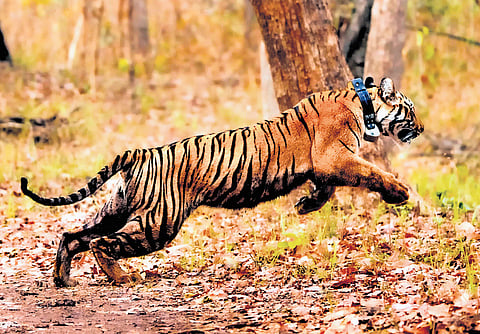

CHENNAI: The state forest department will roll out phase I of the All India Tiger Estimation (AITE) 2026 from January 5. The exercise is being carried out under the national framework led by the National Tiger Conservation Authority in collaboration with the Wildlife Institute of India, with the state forest department playing a central role.
The sixth cycle of the tiger estimation will run through 2026, with the final national report expected in 2027. In Tamil Nadu, phase I will extend from early January till the end of February, with surveys conducted in seven-day cycles across forest divisions covering all tiger reserves as well as other tiger-bearing landscapes.
Tamil Nadu currently has five notified tiger reserves — Kalakad Mundanthurai, Anamalai, Mudumalai, Sathyamangalam and Srivilliputhur-Megamalai — which form a critical part of the southern Western Ghats tiger landscape. According to the previous AITE cycle, the state’s tiger population increased from 264 in 2018 to 306 in 2022 - steady gains made through habitat protection, anti-poaching measures and landscape-level conservation.
As per the revised schedule for phase I, surveys will begin simultaneously in several divisions from January 5, including Pollachi, Udumalpet, Kalakad, Ambasamudram, Srivilliputhur and Megamalai. Other tiger-bearing divisions and corridors, such as Dindigul, Kodaikanal, Theni, Madurai, Nilgiris, Gudalur, Hosur, Dharmapuri and parts of Erode and Vellore, will be covered in subsequent cycles through January and February.
The exercise also extends to buffer areas, core zones, wildlife corridors and select non-protected forest divisions where carnivore presence has been recorded, reflecting a broader landscape-based approach to monitoring.

Chief wildlife warden Rakesh Kumar Dogra said the estimation will not be limited to counting tigers alone. Data will also be collected on co-predators such as leopards, dholes and hyenas, along with prey species including gaur, sambar, spotted deer and barking deer. Habitat quality and human disturbance indicators will be assessed using sign surveys, line transects, camera trapping and genetic sampling of dung and scat.
A key shift in AITE 2026 is the inclusion of forest divisions outside designated tiger reserves, as well as private estates that support tiger or co-predator populations. This is aimed at capturing animal movement across corridors and multiple-use landscapes, which is increasingly important for long-term conservation planning.
The forest department will deploy trained frontline staff, field biologists and volunteers, supported by technology-driven tools such as the M-STrIPES (Monitoring System for Tigers - Intensive Protection and Ecological Status) mobile application and camera traps.
Officials said extensive training events were conducted between November and December 2025 to ensure data quality and uniformity across divisions. Volunteers interested in participating have been asked to register with the respective tiger reserve offices in advance.