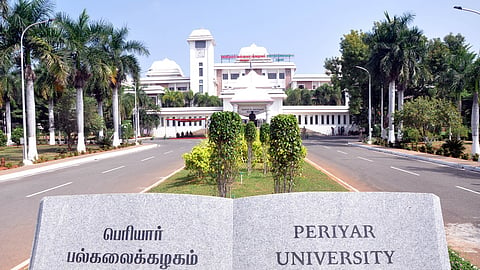

SALEM: Periyar University is set to become the third university in Tamil Nadu to introduce reservation in PhD admissions, adopting a single-window, roster-based system for doctoral research from the December 2025 session.
Under the new system, PhD admissions will be conducted through a single-window counselling mechanism, with vacancies pooled at the university level. For each admission session, the total number of available seats will be calculated and treated as the sanctioned intake. Discipline-wise and roster-wise rank lists will be prepared and published on the university website before the commencement of admissions.
The reservation policy will be implemented across 27 departments at the Salem campus, the Periyar University PG Extension Centre in Dharmapuri, and recognised research centres and affiliated colleges authorised to offer research programmes under the university. At present, only Thiruvalluvar University in Vellore, and Manonmaniam Sundaranar University in Tirunelveli, have implemented reservation in PhD admissions in the state.
Doctoral research programmes at Periyar University are administered by the Directorate of Research. Until now, admissions were conducted based on UGC norms. Candidates were shortlisted through a common entrance test, NET-JRF eligibility, and personal interviews, after which they were selected. University officials said this decentralised system had drawn repeated complaints of subjectivity, lack of accountability and social exclusion.
To address these concerns, the university constituted an expert committee to examine the implementation of reservation in PhD admissions, on the same lines as the undergraduate and postgraduate programmes. The committee also included special invitee professors from Thiruvalluvar University and Manonmaniam Sundaranar University, where the system is already operational.
Based on its recommendations, a detailed framework was submitted to the Board of Research Studies (BoRS), the statutory body responsible for research regulations. The proposal was subsequently approved by the BoRS and cleared at the university's 118th syndicate meeting.
A syndicate member explained that admissions would strictly follow the reservation roster within each discipline. “If a department has 40 vacancies, candidates will be ranked based on NET-JRF, entrance examination, and interview performance. Admissions will then be made purely through the roster system. This ensures representation of socially backward communities in every department and eliminates discretionary selection by individual guides,” he said.
Candidates will be ranked with priority given to NET-JRF and other national fellowship holders, followed by NET-qualified candidates, SET/SLET-qualified candidates, and finally those who clear the university entrance examination. Where candidates from a particular category are unavailable, vacancies will be filled through upward movement of the roster, as per the state government norms, he added.
A professor from Manonmaniam Sundaranar University in Tirunelveli, who was also part of the Periyar University’s expert committee, said the single-window system had transformed research admissions. “Just as undergraduate and postgraduate classrooms are socially diverse, doctoral research spaces must also reflect that diversity. A centralised admission process ensures the rightful representation of socially disadvantaged communities in every department and affirms their democratic right to access higher research,” the professor said.
K Raja, General Secretary of the Association of University Teachers (AUT), said, “There is no clarity yet on how the system will be implemented on the ground. We will have to wait and see how it is carried out.”
