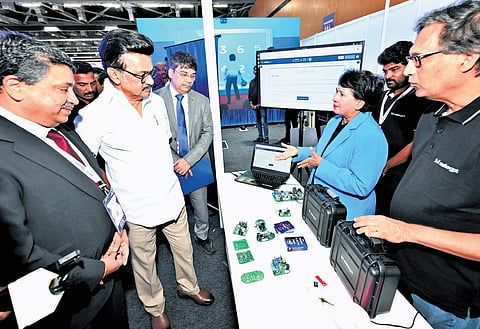

CHENNAI: Agreements worth Rs 9,820 crore that would generate around 4,200 jobs were signed at the fourth edition of UmagineTN 2026, the state’s flagship information technology summit, on Thursday. Speaking at the event, Chief Minister MK Stalin said Tamil Nadu’s transition into a technology-led economy has been shaped by the state’s Dravidian model of governance, which treats technology as an instrument of social advancement rather than merely a driver of headline economic growth.
Memoranda of understanding (MoUs) were signed with EROS Gen AI, Better Compute Works Inc, Phantom Digital Effects Limited, Rewin Health, Cube84 and WeLoadin Studio LLP for industrial investments.
Stalin said sustained investments in deep-tech skilling, a forward-looking data centre policy and long-horizon research infrastructure were repositioning Tamil Nadu from a conventional IT services hub into a broader technology and innovation powerhouse.
The state’s ambition, he said, was not merely to keep pace with peer states, but to remain structurally ahead in technology adoption and innovation. “UmagineTN, in that sense, mirrors the Dravidian model’s long-standing emphasis on modernisation combined with social justice, an approach aimed at ensuring that the gains from technology are widely distributed rather than narrowly concentrated,” he said.
Stalin credited Information Technology and Digital Services Minister Palanivel Thiaga Rajan with shaping the summit’s long-term vision and expanding its outreach, particularly among students and young professionals. Sustained public engagement on technology policy, he added, was critical if digital transformation was to translate into tangible social outcomes instead of remaining confined to industry circles.
Placing the state’s current position in a longer historical context, Stalin recalled early policy choices under former chief minister M Karunanidhi who viewed technology as a tool of citizen empowerment rather than an elite resource.
During the event, Stalin released the Tamil Nadu Deep Tech Startup Policy 2025-26, which he described as India’s first state-level deep tech startup policy.
The five-year policy aims to support 100 deep-tech startups, mobilise Rs 100 crore in public and private investments, facilitate technology transfer and intellectual property commercialisation, and train more than 10,000 students and professionals in advanced deep-tech skills.
