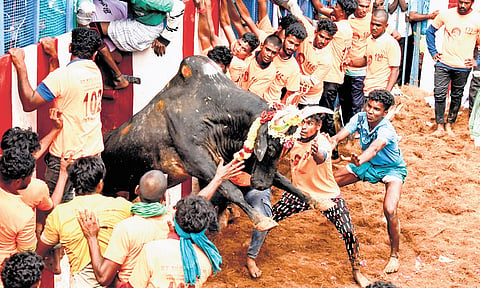

CHENNAI: Even as jallikattu events have kicked off in delta districts and other regions, a section of bull owners and jallikattu enthusiasts have alleged a lack of transparency in the process of issuing tokens and permissions for bulls to participate. They claim that officials lack the expertise to assess whether a bull is capable of performing well in the sport.
According to them, bulls are allowed to participate in major venues such as Alanganallur, Palamedu and Avaniyapuram in Madurai, and other locations based purely on subjective judgment, without following any scientific or transparent criteria. As a result, bulls that lack the necessary capabilities and unable to perform effectively are also permitted.
Sources from the State Animal Welfare Board said that veterinary officials and revenue authorities primarily ensure that no cruelty is inflicted on animals and that the bulls are medically fit to participate in the event. “We do not have any mechanism to assess a bull’s ability to perform or succeed in the sport,” an official said.
Bull owners are required to register their animals on ahd.tn.gov.in/jallikattu/ to obtain tokens and approval for participation. On average, between 1,000 and 2,000 bulls are registered for each event held in Madurai, Pudukkottai, Tiruchy, Sivaganga, and other districts.
Tiruchy-based jallikattu activist D Rajesh from Jallikattu Meetpu Kazhagam said, “If 2,000 bulls are registered for an event in Madurai, only about 600 to 700 are eventually allowed to participate through online tokens.” The jallikattu registration portal is managed by revenue officials (tahsildar) on behalf of the respective collector in every district. These officials grant approval for bulls to participate in events, allegedly relying largely on subjective assessments, added Rajesh.
Madurai-based bull owner S Santhana Pandiyan claimed, “Approvals for bulls to participate in the Alanganallur and Peelamedu events are often granted to those with political influence. The approval system should be reformed to include bull owners who spend years rearing bulls specifically for jallikattu. Many owners who were denied permission to participate in Madurai eventually sold their bulls.”
A senior official from the State Animal Welfare Board said that as per the standard operating procedure (SOP), jallikattu should be conducted only between 6 am and 2pm, during which a maximum of 400 bulls can be permitted. However, due to pressure from local communities, permissions are often extended to allow 600 to 700 bulls. “Based on the feedback from stakeholders, we will look into the matter,” an official said.
In 2025, a total of 352 events comprising jallikattu (bull taming), Eruthu Vidum Vizha (bull racing), and Manju Virattu (bull chasing) were conducted in 19 districts, involving approximately 1.14 lakh bulls. However, in 2024, only 214 such events were held.
