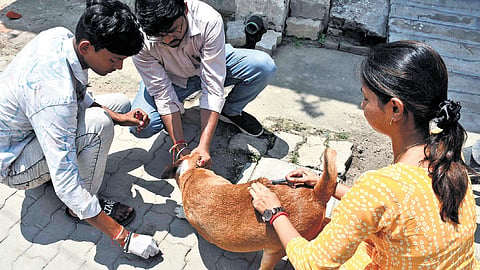

CHENNAI: Data obtained through the Right to Information Act from the Directorate of Public Health and Preventive Medicine show that Tamil Nadu has, over the past 10 years, spent over Rs 120 crore on anti-rabies vaccines (ARV) and rabies immunoglobulin (RIG). The procurement increased from 3.87 lakh ARV doses in 2015-16 to over 9.36 lakh doses in 2024-25. Over the same period, however, the state saw 255 human rabies deaths, with 2024 alone accounting for 47.
Experts say this paradox, rising expenditure but persistent deaths, stems from a fundamental policy flaw. Rabies surveillance begins only in humans, even though the virus originates in animals, mainly dogs. Data show that human rabies deaths were reported every year over the past decade, with several deaths recorded as recently as 2024-25. Of the 255 deaths between 2016 and September 2025, 74 were caused by bites from pet dogs, challenging the common perception that rabies is solely a stray dog-related issue.
Public health experts argue that unless rabies in animals is declared a notifiable disease, the state will continue to respond too late, after infections spill over to humans, when survival is almost impossible.
In April last year, the Madras High Court directed the state to consider a representation seeking to declare rabies in animals as a notifiable disease. While disposing of a petition filed by animal welfare activist Antony Clement Rubin, the court asked the Health and Family Welfare Department and the Animal Husbandry Department to examine the plea and respond within 30 days. However, no action has been taken so far.

Rubin told TNIE that rabies deaths reflect failure in early detection. “India accounts for around 36% of global rabies deaths, yet we still act only after people are bitten. Tamil Nadu alone saw nearly 7 lakh dog-bite cases last year and dozens of human deaths. These are not medical failures, they are surveillance failures,” he said.
A working model for elimination already exists within India. Goa became the first Indian state to eliminate human rabies through animal disease notification, mass dog vaccination, surveillance and public education. A peer-reviewed study published in Nature Communications documents how Goa reduced canine rabies cases by 92% and brought human rabies deaths down to zero by 2018-19. Between 2013 and 2019, Goa vaccinated over 4.26 lakh dogs, consistently achieving the critical 70% vaccination coverage required to interrupt transmission. Karlette Anne Fernandes, Director of Companion Animal Management at Worldwide Veterinary Service (WVS), said the cornerstone of Goa’s success was mandatory reporting of animal rabies. “Notification ensured every suspected rabid animal was reported, tested and mapped. That data guided vaccination teams to hotspots instead of blanket, inefficient responses,” she said.
Fernandes added that Tamil Nadu already spends heavily on post-exposure treatment, but prevention would be far more effective. “Declaring rabies in animals as notifiable shifts the system from crisis management to prevention at source. That is how Goa succeeded — and how Tamil Nadu too can,” she said.
Official correspondence from P Senthilkumar, principal secretary to the Health and Family Welfare Department, acknowledges that rabies is currently notifiable only in humans under the Tamil Nadu Public Health Act, 1939, and argues that animal diseases fall outside its scope. The Animal Husbandry Department, despite rising human deaths and public outrage, has failed to intervene.