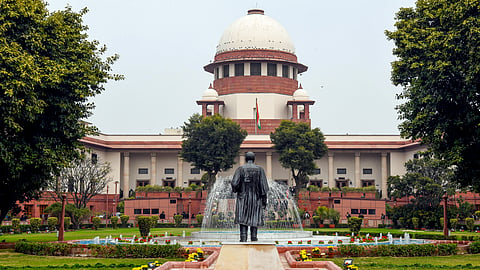

The Supreme Court on Thursday stayed a Madras High Court direction ordering the eviction of Shanmugha Arts, Science, Technology & Research Academy (SASTRA) from government land in Thanjavur, after noting that the Tamil Nadu government should not make a dispute of a "prestige issue."
The top court in its order asked the Tamil Nadu Government to consider the University's offer of alternate lands.
The bench acknowledged that the encroachments on public land could not be regularised as a matter of policy but emphasised that the case involved a welfare-oriented institution rather than a commercial entity.
"A welfare state must take into account the role played by such institutions in furthering public interest," said a three-judge bench comprising Chief Justice Surya Kant and Justices Joymalya Bagchi and Vijay Bishnoi.
It added that the land has been utilised for decades by a university performing a public function.
"States must be sensitive in dealing with such institutions,” the court said and asked the state government, represented by senior advocate Rakesh Dwivedi, to set up a high-powered committee of three senior state officials to consider SASTRA's representation and accord the institution a hearing before deciding the issue in four weeks.
The court also asked the state to act "sensitively" while dealing with public educational institutions, the bench said till the time the representation is decided by the panel, the functioning of the institution should not be hindered.
The case pertains to 31.37 acres of government land that is interspersed with and contiguous to SASTRA's own patta land.
The university claimed that the disputed land has long been integrated into its campus, hosting academic buildings, hostels, utilities, and access roads. The land is essential to the university's operations, which serve more than 12,000 students across disciplines like engineering, law, management and liberal arts.
Advocate Rakesh Dwivedi, appearing for the State of Tamil Nadu, submitted that if the petitioners' case is allowed, then every other encroacher of the public land would make the same argument and ask the government to take alternative land instead.
The CJI, however, pointed out that in the present case, the land was being used for promoting education, which is on a different footing than a commercial site.
"Had it been a case of a factory or a commercial institution, we could have appreciated that you know - you have already made money out of an illegally encroached land. They (petitioners) are an (educational) institution," the CJI said.
He further added, "They are giving you three options; as a state, you should also promote educational institutions. How many states have been able to establish educational institutions?
When Dwivedi submitted that the petitioners can send a new proposal for the state's consideration, the court allowed it.
