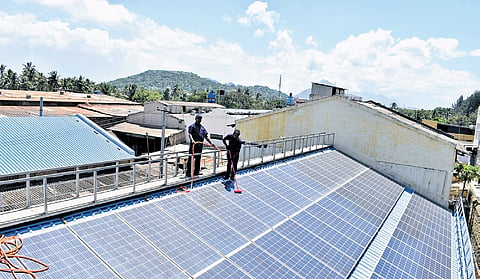

CHENNAI: Tamil Nadu is lagging behind Gujarat and Rajasthan in adding new renewable energy capacity, particularly solar power, over the past nine months, with developers blaming the rejection of several project applications by the Tamil Nadu Electricity Board (TNEB).
Data from the Union Ministry of New and Renewable Energy (MNRE), accessed by TNIE, show that between April and December 2025, Gujarat added 7,032 MW of solar capacity, while Rajasthan commissioned solar plants totalling 8,371 MW. In contrast, Tamil Nadu added only 1,511 MW of renewable energy capacity during the same period, highlighting TN’s weak performance in new installations when compared to the rapid growth seen in the two western states.
However, Tamil Nadu continues to top south India in terms of overall installed renewable energy capacity. As of December 2025, the state had an installed capacity of 27,113 MW, ahead of Karnataka’s 25,983 MW. Nationally, Gujarat and Rajasthan occupied the top two positions, with Gujarat recording a total renewable energy capacity of 42,583 MW, closely followed by Rajasthan at 42,531 MW.
Responding to the criticism, Vishnu Mahajan, joint managing director (Finance) of TNEB, denied allegations that applications for new renewable energy projects were being rejected. He told TNIE that Tamil Nadu has been adding between 2,000 MW and 2,500 MW of solar capacity in recent years. “We have not rejected all applications. In some cases, feasibility reports, including the availability of power transmission and evacuation facilities, are examined before approvals are granted,” he said.
“We are strengthening transmission infrastructure through the Green Energy Corridor (GEC). Work on GEC-I and GEC-II is under way, and approval has also been obtained for GEC-III. Once these projects are completed, Tamil Nadu will be able to evacuate more than 10,000 MW of additional renewable energy,” he added.
He also cited land constraints as a limiting factor. “Compared to Gujarat and Rajasthan, Tamil Nadu has limited land availability. Most suitable parcels have already been utilised, which is also affecting the addition of new capacity,” he said.
However, K Venkatachalam, chief Advisor-cum-CEO of the Renewable Energy Producers Association, told TNIE that electricity board has rejected more than 200 applications for new renewable energy projects, including solar, in recent months. He urged the state government to place in the public domain details of applications received and rejected. At present, the state does not have a solar energy policy, and there has never been a separate policy for wind energy.
This lack of clarity, developers said, has made investors wary of committing fresh investments in the state’s renewable energy sector.
