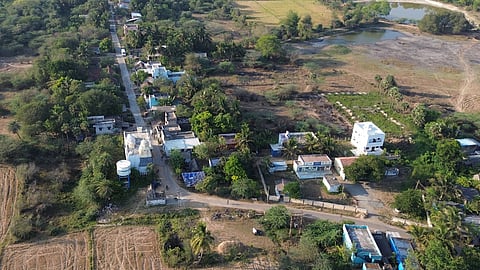

CHENNAI: Even as the government is steadfast in constructing the proposed greenfield airport in Parandur despite opposition from local farmers and residents, a city-based research organisation has warned that about 10,000 to 12,000 cusecs of additional floodwater will enter Adyar and Cooum rivers in case of peak rainfall hours if the airport is constructed, which would put the city at risk of flooding.
As per a report prepared by Uvakai Research Foundation, neither the Adyar nor the Cooum has effective floodplains, making Chennai highly vulnerable to flood when river flows exceed carrying capacity. “No evidence is provided in the pre-feasibility report to demonstrate that Chennai’s rivers -- already operating beyond their hydraulic capacity during extreme rainfall -- can safely accommodate this additional flood load,” the report said.
The report further claimed that the pre-feasibility report prepared by TIDCO incorrectly classified the Parandur site as part of the Lower Palar basin. Hydrological analysis shows that approximately 66% of the project area lies within the Cooum river basin, while 34% falls within the Lower Palar basin.
In addition, the Kamban Kalvai crossing the site conveys water towards Chembarambakkam Lake in the Adyar basin, establishing a functional linkage to the Adyar river system. All runoff from the airport site ultimately passes through Chennai, which is already heavily urbanised and flood prone, as per the report.
Pointing out that the airport project is being advanced without adequate hydrological justification, Uvakai Research Foundation demanded the state and the central governments to immediately stop further approvals and land-use conversion apart from conducting an independent, basin-scale hydrological and flood modelling.
In 2017 Comptroller and Auditor General report on Chennai floods of 2015, it was highlighted that the reason for flooding was the absence of basin-based planning, despite Chennai’s flood risk being driven by interconnected catchments.
Fragmented drainage and flood control works, implemented without considering upstream runoff or downstream carrying capacity was also pointed out.
“The Parandur airport proposal reflects the same governance failures flagged by the CAG and risks repeating past mistakes that have already worsened flood vulnerability in Chennai,” the foundation said.
