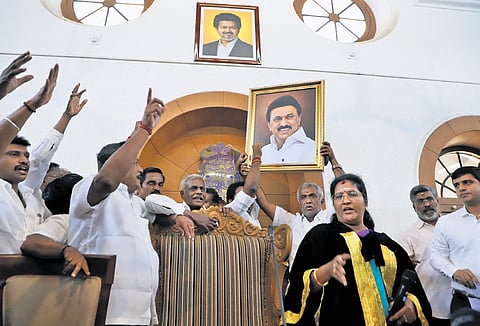

CHENNAI: Political battles over portraits have become an unlikely feature of civic body meetings in Tamil Nadu. Recently, councillors in the Tiruppur corporation clashed over displaying portraits of former CMs MK Stalin, K Kamaraj and Edappadi K Palaniswami. A similar scene played out in Sivagangai municipality, where an independent councillor proposed displaying actor Trisha’s photograph. The episodes raise a simple question: Who can have their portrait displayed in government offices?
Government orders issued over the past five decades permit the display of portraits of the chief minister, former chief ministers and several national and state leaders in public offices. However, none of these orders makes it mandatory. Significantly, every government order uses the word “may”, making the provision optional rather than compulsory.
The first comprehensive order, G.O. (Ms) No. 47, was issued by the Public (General-I) Department on January 7, 1978, to end this confusion. It permitted the display of photographs of the incumbent President and Prime Minister of India, Mahatma Gandhi and former PM Jawaharlal Nehru in public offices and buildings.
For Tamil Nadu, the list included Saint Thiruvalluvar, former CMs C Rajagopalachari, K Kamaraj and Arignar Anna, besides social reformer Thanthai Periyar. The G.O. also directed that portraits of “all others may be removed”. The list was expanded through G.O. (Ms) No. 2363, dated October 24, 1990, which added Dr BR Ambedkar.
Even then, the order merely stated that his portrait “can also be displayed”, retaining the optional nature of the provision. A more significant expansion came in 2006 through G.O. (Ms) No. 457, dated June 4. It added freedom fighters Pasumpon Muthuramalinga Thevar, VO Chidambaranar and Quaid-e-Millath, along with former PM Indira Gandhi.
Crucially, the order also permitted the display of portraits of the incumbent CM and former CMs of TN, taking the total number of eligible categories of leaders to 16. Yet, the wording continued to be enabling rather than mandatory.
The Madras High Court has also endorsed this interpretation. During the hearing of a writ petition in 2021 seeking mandatory display of the President’s and prime minister’s portraits in all government offices, the then Advocate General informed the court that the relevant government notification merely gave offices the option to display one or more portraits of the approved leaders.
An IAS officer of secretary rank, speaking to TNIE, said the decision rests with the government. “The incumbent CM’s picture will be displayed, but the display of pictures of other leaders is the choice of people in that particular office,” the officer said.
