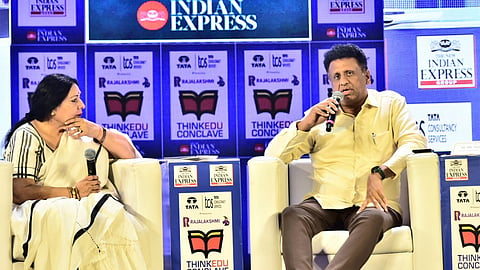

CHENNAI: MC Sudhakar said the National Education Policy 2020 is more workable for private and deemed universities than for public institutions, citing faculty shortages and infrastructure constraints, while speaking at the 14th ThinkEdu Conclave organised by The New Indian Express in Chennai.
In conversation with Sunaina Singh, former Vice Chancellor of Nalanda University, on the theme “The New Curriculum: Reimagining Education”, Sudhakar highlighted the practical challenges of implementing NEP 2020, particularly with regard to multidisciplinary learning, multiple entry and exit options, and structural flexibility.
Sudhakar pointed out that Karnataka was the first state in the country to implement NEP 2020.
However, he said his Congress led government believed the previous administration had rolled out the policy in haste, without adequately addressing ground realities in public higher education institutions.
Hence, the Congress party set up a panel to draft a State Education Policy immediately after coming to power in 2023.
“Drafting a State Education Policy (SEP) was a part of our manifesto,” said the minister, adding that the expert committee has already submitted its report.
Sudhakar said that NEP 2020 is workable and better suited for private and deemed universities but not for public institutions. He noted that private universities enjoy academic autonomy and operate integrated campuses offering engineering, humanities, medicine and social sciences under one roof, enabling smooth academic mobility across disciplines.
In contrast, he said, public universities largely cater to students from economically weaker backgrounds and face serious faculty shortages and infrastructure constraints.
He pointed out that the biggest challenge in implementing NEP 2020 is the shortage of faculty. Many institutions rely heavily on guest faculty, making it difficult to offer diverse electives such as cybersecurity or interdisciplinary courses.
Sudhakar emphasised that implementing multidisciplinary education requires substantial faculty strength, physical infrastructure and financial resources, which public universities often lack.
Therefore, without strengthening foundational capacities, he argued, NEP’s multidisciplinary ambitions may be impractical for the public higher education system.
“In Karnataka alone, over 14,000 guest faculty are engaged despite UGC norms capping such appointments at 20 per cent,” said Sudhakar.
While the state has recruited 1,200 assistant professors and sanctioned 2,000 additional posts, substantial vacancies still persist. Regulatory bodies such as AICTE mandate strict student faculty ratios, making sustained recruitment essential, he highlighted.
In the context of curriculum reform, Sudhakar emphasised that reform must focus on strengthening foundations, building industry aligned and dynamic syllabi, and investing in faculty and infrastructure.
“Without working on these factors, implementation of multidisciplinary courses may remain aspirational in public universities,” he said.
