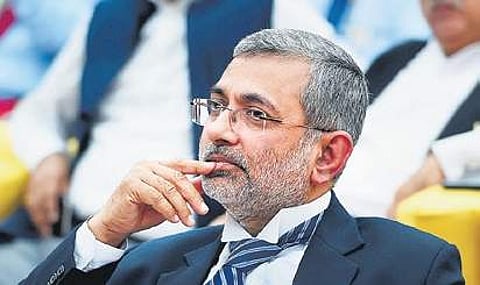

It's not at all unusual for a new government to walk away from the various schemes and initiatives of the previous government. The decision of the C Joseph Vijay-led TVK government on Nov 6 2026, to disband the high-level committee on Centre-State relations (chaired by former SC judge Justice Kurian Joseph), however, was the subject of widespread criticism.
The decision was quite a shock given the extent to which the ruling party has publicly affirmed its commitment to the constitutional, political, linguistic and financial rights of Tamil Nadu.
The TVK government pointed to overlapping functions as one of the reasons for the dissolution of the committee. The government noted that the functions of the committee were in some way overlapping with those of the Tamil Nadu State Law Commission, which was reconstituted on August 7, 2026 with a wider mandate to cover Centre-State and inter-State relations.
The government therefore saw absolutely no point in having two bodies doing the same job. It also made the point that the Kurian Joseph Committee was an executive appointed, non-statutory body.
The committee was set up on April 15, 2025 by the MK Stalin-led DMK government. In addition to Justice Kurian Joseph, the panel also had Ashok Vardhan Shetty (retired IAS officer) and Prof M Naganathan (former Vice Chairman of the State Planning Commission).
Its mandate was to look at Centre-State relations and to make recommendations as to how the autonomy and constitutional position of the States could be safeguarded.
What led the DMK govt to set up the committee
According to P Wilson, Rajya Sabha MP (DMK) and senior advocate, the federal issues in TN have been on the rise over the last few years. The NEET Exemption Bill which passed twice in the Assembly was effectively stalled for a long period of time with the Governor and the President both refusing to give assent. The state then went to the SC which in April 2025 held that the Governor had acted "unconstitutionally".
The state, he added, also had Rs 2,500 crore of Samagra Shiksha funds withheld on account of Tamil Nadu's opposition to the National Education Policy (NEP) and the three-language formula. Centre-State relations were further strained over issues of population-based delimitation, the diminishing powers of the state in terms of taxation under GST, the increasing burden of cesses and surcharges and the conditional nature of the centrally sponsored schemes.
Wilson also pointed out that the constitutional framework governing Centre-State relations has never been properly reviewed since the Punchhi Commission report of 2010. All the major developments since then have been in the sphere of federalism (the introduction of GST, the abolition of the Planning Commission, the reorganisation of J&K, the proposal for simultaneous elections and the NEP). The Justice Kurian panel was set up in that context.
Panel's first report submitted to Stalin
The panel's first report was submitted to CM Stalin on February 16, 2026 and was tabled in the Assembly the next day.
The 387-page report looks at a range of constitutional, political and administrative issues relating to the federal structure of India.
The report is a full and up-to-date analysis of Centre-State relations, based on the Rajamannar Committee, the Sarkaria Commission, the Punchhi Commission and other relevant reports and studies. It favours a federal structure in which the states have real constitutional powers of legislation and administration.
Meanwhile, on May 4, 2026, Prof Naganathan (very obviously with a political connection) resigned from the committee following the coming to power of the Vijay-led TVK government.
His son Dr Ezhilan Naganathan (Secretary, DMK Doctors' Wing) gave the reason for his father's resignation in an interview with The Wire. Ezhilan says his father felt the incoming TVK government would not only very likely block the work of the committee but would also not appreciate the significance of the committee's mandate. That's why he decided to step down.
Attempt to appease BJP?
Speaking to TNIE.com Ezhilan Naganathan said the government's move was an attempt to placate its BJP masters.
He pointed out that state autonomy/state federalism has been the central issue and the fundamental principle of the DMK since 1967. The Rajamannar Committee was set up in 1969 by the DMK government with the sole task of looking into Centre-State relations and recommending the constitutional changes necessary to achieve the maximum possible degree of autonomy for the states without in any way compromising the unity and integrity of the country.
He went on to say the Justice Kurian Committee was set up in the context of the centre's steady encroachment on the rights of the states in various spheres, particularly language and federalism.
"In the post-globalisation world there was a very real need for up-to-date documentation which would take a genuinely holistic 360-degree view of the situation, particularly the erosion of the State's autonomy in education, health, the environment, etc.," he observed.
He also said the Vol II report of the committee would have covered the financial relationship between the Union and the States, judicial reform and a whole host of other important aspects of the federal government.
Unfortunately, the committee was dropped one day with absolutely no discussion at all of Volume I or its recommendations, he added.
Wilson cited reports saying that staff and research contracts of the committee were not renewed after May. Reports in September said there was pressure on Justice Kurian Joseph to resign, and that he had not been given a meeting with the Chief Minister. The order to disband the committee came after 7 p.m. on the evening of November 6, before a long weekend. "That is how a government ends something it does not want to defend in public", he signed off.
