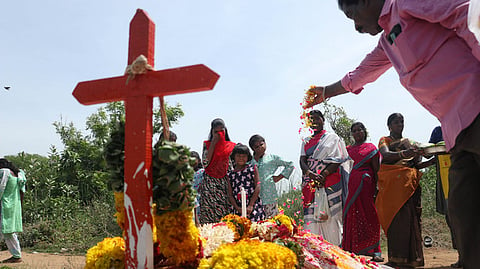

CHENNAI: The Justice B Gokuldas Commission, constituted to inquire into the causes and circumstances leading to the deaths of 70 people after the consumption of arrack-mixed methanol in Kallakurichi in 2024, has held officials across departments responsible for the tragedy.
Lapses by police, prohibition and excise, prohibition enforcement wing (PEW) and revenue departments contributed to the deaths in Karunapuram and neighbouring areas, the panel said.
Negligence and intelligence and systemic failures contributed to the tragedy, said the report tabled in the Assembly on Tuesday. The one-man panel — constituted in June 2024 and mandated to file report by September that year — submitted its report on February 14, 2025, to the previous DMK government, but it was tabled in the Assembly only on Tuesday after nearly 18 months.
Illicit arrack sellers picked through auctions, says panel
The commission said the incident, which occurred between June 17 and 20, 2024, claimed the lives of 70 people and left 161 others with injuries ranging from partial to permanent disability. A total of 231 people had consumed the methanol-mixed arrack supplied by local vendors.
The commission revealed that in some villages, including Seshasamuthiram and Madhavacherry, village welfare committees conducted unlawful auctions to select persons to sell illicit arrack within the village limits. Successful bidders were required to pay around `5 lakh after which they were allowed to sell illicit arrack without interference. Villagers who opposed the arrangement were allegedly threatened with social exclusion, the report said.
The 650-page report based on inquiries with more than 400 persons, including the affected persons, kin of the deceased, police personnel and activists, recommended setting up a separate Prohibition Enforcement Wing for Kalvarayan hills, besides urging the government to provide education, food and shelter to children orphaned by the deaths of their parents in the tragedy, and providing preference in government jobs to eligible members of the affected families.
“If the authorities vested with powers to monitor and scrutinise the storage, transportation and sale of methanol had been diligent in discharging their duties, the killer chemical could not have found its way from Chennai to Kallakurichi,” the commission observed.
Despite a circular issued by the DGP in May 2023 following the Marakkanam hooch tragedy, another such incident occurred in Kallakurichi in June 2024. This, it said, “speaks volumes of the grave negligence and callous dereliction of duty” by the authorities concerned.
It also highlighted the shortage of staff at police stations, PEW and other departments, stating that inadequate manpower had hampered regular raids in the Kalvarayan Hills, where illegal brewing and distillation were suspected to have been carried out on a large scale.
The report noted that the accused arrested by the CB-CID neither possessed the requisite licence to import, transport, store, use methanol in the manufacture of other substances or sell it, nor did the person who received the chemical had a valid licence to do so.
The commission said the practice had been taking place with the passive connivance of police and revenue officials at the ground level. The money collected through the arrangement was reportedly used for common purposes, including temple festivals and renovation of public structures.
