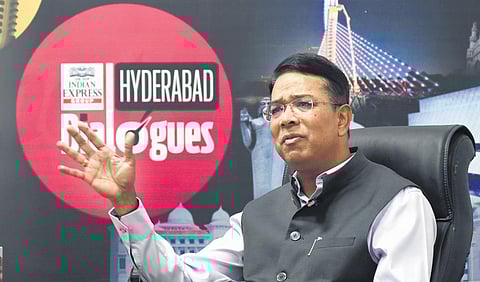

How are you preparing for the Telangana Assembly elections?
The biggest, most-time consuming thing for us is to train and put the appropriate people in place. Placing them in such a way that there is no bias while ensuring randomisation is also important. The second important thing is the EVM. That is where the interaction with the voters actually takes place. EVMs have stabilised now but it is getting modernised every time. In the initial phase of introduction of EVMs, we had to tell people what the machine is and how to use it. Many times, people used to tap the symbol of the party instead of the button next to it. However, now that problem does not exist.
Polling stations are the next big challenge. There are about 35,000 to 36,000 polling stations in the State and all of them have to be equipped with all the facilities. Small things such as procuring and placing incandescent bulbs too have to be taken care of.
Now, it is becoming more and more important for us to take care of IT. There are almost 17 different types of softwares that are deployed. Some of them can be used by the voter, others are available only to political parties and some are purely internal — to be used by us. Putting trained people in place is important. We need to understand that our work is not something that goes on throughout the year for five years at a time. We need these people only for two or three months. It’s not easy to get such highly trained people for such a short period of time. So we have to train people and still ensure that no mistakes occur.
So the training process might be starting fairly early then?
Oh yes, it has been going on for the past six to eight months. Updating e-rolls is an important task. Even after the last date of receiving applications for the final electoral roll, which was September 19, we have received about 7-8 lakh forms. So this process keeps on going, we need to continuously update it.
When it comes to elections, the first thing that comes to mind is the flow of money and liquor. How exactly does the integrated expenditure monitoring software work? How does it help in checking the flow of money?
There are two parts: one is collating the information from various sources. We have requested the banks to give us information about accounts where a lot of money is moving. The RBI moves cash in chests. We monitor the areas where cash chest movement is high.
A lot of digital payments are happening these days. If what has started happening from a particular account is different from what was the case for the last six months, then we need to check. The software platform is basically to bring all this information together, whether it is from the RBI or the banks,and then put it in the frame of the Income Tax and the police departments. Then they are able to take action. This is one part of expenditure monitoring.
The other part is at the field level. Under the expenditure observer, there is a team. That team has finance department, people from our side and some I-T people too, if needed.You must have seen the news about the rates for all sorts of things from biryani to tea. Political parties have their rallies and meetings.
The moment they do a rally and they take permission from our people, we will deploy a team with a camera to record everything that is happening. Based on that, our team will make their own estimate. There is the Rs 40 lakh expenditure limit. Whenever they are able to find any discrepancies, we act on it. Since it is recorded, there is evidence from our end.
Has there been an instance where the expenditure of Rs 40 lakh was crossed, what action was taken?
They can be disqualified, I think it has happened in some cases. The problem is always proving that it is beyond the limit. It is contested by the candidate who says this or that expenditure was not mine. Our shadow expenditure that I was talking about earlier, our people will say that look, this expenditure was there, and then the candidate will come up with some explanation. Then if it goes further from our side, then the candidate goes to the court also and says that I’m being harassed. So it’s a long process. Proving that the candidate made more expenditure than the spending limit, it becomes a process that is contested.
After the 2018 elections, so many cases have been filed in the high court with regard to wrong affidavits. What measures are you taking to avoid wrong affidavits from being filed in the first place?
The ECI has said that once the affidavit is filed by the candidate, it is the responsibility of the returning officer to see that every column is filled. Whether that information is correct or not is not the responsibility of the returning officer. Election petition is primarily the purview of the court.
Political parties are promising the moon. The ECI has advised parties to explain to the voter the feasibility of implementing their promises. Is it just an advice or do parties have to submit their manifestoes and give it in writing that this is feasible?
Our goal is basically to make the system transparent, whatever is being told by the political parties should be available to everybody to see. So, it is up to the public to decide. The same thing is there for the affidavit and criminal antecedents. Our role in these things is primarily to make the people educated.
Do you monitor the media?
There is so much news coming in from print, social media and various other platforms, we have to keep looking at whether there is any MCC violation being reported. If reported, then we need to make an effort to stop that.We have created a platform for people to complain directly. So just to give you an example, in the last four or five days, we have received over 400 complaints on the cVigil app and this is just the beginning and it will start piling up once we come closer to the election date. Everything from telling the people to use the platform and being able to respond to the complaints is our job. Our systems have to ramp up appropriately to see that we are able to take action on those things. So, this is basically the broad spectrum of activity that we do for the elections.
Is there any time limit to resolve the complaints received on cVigil app?
100 minutes is the mandate given by ECI. So, basically, the way the system functions is that we have five squads operating all over the State, every constituency is supposed to be having three. The moment a complaint comes, along with it the location of the complainant also comes. So they know exactly how far it is and then based on that the action is taken.
How is the anonymity of the complainant maintained?
The ECI protects the complainant’s information. So it will not go even to the SSP or the team who is supposed to act on the complaint. They will only be told that from such a location, such a complaint has come.We no longer need anything to come from the complainant, except the photograph or the video that he has uploaded. He has done his part, he’s free to give his name or put the complaint anonymously. So we don’t even need his help further on that. So after that, it is our team that goes there, checks whether there is actually a violation. And then based on whatever rules are there, action is taken based on that.
If I receive a video of some violation, how do I report it to the ECI anonymously, since the cVigil app does not allow me to upload a video or a photo from my gallery?
Such things can always be given along with a covering letter to the returning officer or the DEO. Complaints can also be made on the toll-free number 1950. cVigil is an app that is available for the purpose of then-and-there reporting.
Have you used the cVigil app?
I have not made a complaint on the app (smiles)
The audio seems to work. But even if all the necessary permissions are given to the app, the photo and video feature do not seem to work. We tried it on different phones.
Let me check up. As per the numbers that are coming to me, 471 complaints have been registered. I do not have the audio and video breakup.
There is a feature on the cVigil app that shows the number of complaints registered in nearby areas. It says zero on the app currently.
Only 25 complaints have been registered in Hyderabad. Not many people are using the cVigil app in Hyderabad (smiles)
Most of the UPI/digital payments happen on the day of the elections, so how does the ECI act on it immediately?
Let’s see, this is the first time we are getting into digital payments. There will be some delay in the information. So we can start looking at the trend of movement from certain accounts. Maybe it will become a post-mortem for that last particular day. But then from the beginning itself, if we keep looking at such transactions, then people will definitely be more careful.
For the first time, you are using the photos of the candidates on the EVM. What is the purpose and how will it help?
This was a point that was raised by some political parties. They say there is confusion created when the symbols are similar, that many of the voters are not able to read and that some people don’t have very good eyesight. So, the ECI has decided to use photographs too.
In Hyderabad and Secunderabad, voter turnout is usually very low. What according to you is the reason behind it and what is the ECI doing to encourage voters?
This is one of the biggest concerns for us. So, this time, we have made it a point to tackle the issue head on. We have identified 29 constituencies where the polling percentage was less. All of them are urban or semi-urban at least.
All are in Hyderabad?
No. 24 are in Hyderabad and its surroundings, and five are outside — urban areas such as Karimnagar, Nizamabad and Warangal.We are reaching out to voters and giving them information about their polling stations through the voter information slip. We have started distributing the slip early this time.
There are other small things that we will be doing like reaching out to gated communities, multi-storied buildings, IT offices, etc. These are the places where voting percentages are low. We are trying to tell employees through their HR that casting a vote is something that they absolutely have to do and not treat the polling day as a holiday.
In addition, especially in urban areas, many people will be coming in their four-wheelers and two-wheelers. So we have decided to make parking arrangements near the polling stations as well and assure them beforehand that there will be hassle-free parking.
There are also the facilities that we are going to give in the polling stations. The experience of voting should not become a problem. It should be a happy event where the voters had access to proper facilities and did not have to wait too long. We will be doing multimedia campaigns too. But then that has been done earlier too. So we will be trying to focus more on specific houses.
What GHMC does is they make stickers. They put them on the houses of people saying that this is the voting date as a reminder. So basically, touching every house in some way and telling them that this is something that we expect you to do is what we aim to do.
Ultimately, of course, the decision has to be taken by the voter to come and vote. All that the voter has to do is bring his ID; 12 IDs have been specified by the ECI in addition to the EPIC card.
We are trying to motivate companies to encourage their employees. On the stick side, companies can ask the employees to show the ink on their finger to avail a holiday. On the carrot side, organisations can maybe offer free food to those employees who have casted their vote.
After the 2018 elections there was a controversy, it was taken to court as well, that the number of votes polled was higher than the number shown by VVPATs. There was a discrepancy, what could have gone wrong?
I will guess what might have happened based on my experience with the Munugode bypoll. On the day of counting, there is a lot of competition between various TV channels to show that we are the first to tell what the percentage is and what the results are. Without authorised numbers coming out, they start scrolling the numbers.
Then I start receiving phone calls that TV channels say the fourth round of counting is complete, while you are saying that the second round is going on. I then told my returning officer that you or the designated ARO go and inform the roundwise numbers. Every round, the observers have to certify that they are satisfied with the counting. Once they start taking some time, the people outside start getting jittery and start reporting that some problem is there.
Unlike the poll day, where it is an open environment, counting day is a totally controlled activity. There are three police cordons. On every table, there is a counting agent from the candidate side; on the RO’s table too, there is an election agent sitting, the candidate himself is sitting there. There is no way anything can go wrong. Delays can happen because of various reasons.
One thing that you raised was the count of VVPATs not matching with the count of the actual votes. What I guess must have happened is that VVPAT boxes were not cleared after the mock poll. So VVPAT gives a different number, the machine gives a different number. So people start getting doubts.
Candidates do not seem to be worried about the MCC violations, hate speech or some other violation, can the ECI do anything beyond serving a notice?
That’s not 100% true, people have been dragged to forums and people have lost elections that they have won because of various reasons related to MCC. But the model code of conduct, if you see the actual book, is a thick book.
Political parties being mature, and having so much machinery available with them, are expected to follow those things. So that’s why I said basically, the endeavour of the commission is always to conduct the election in an orderly manner. So that it’s a level playing field for everybody, they should be able to say what they want to do for the public. And it is for the public ultimately to decide whom they want to vote for.
Political parties themselves have come forward and agreed to abide by the MCC. No party says we won’t agree to it. Now, what happens at the field level is somebody is doing something (violations). So therefore, the machinery at the field level then gets into picture and then takes action on that I mean, simple things like defacement of property: every political party knows they’re not supposed to use government buildings or even private buildings for putting up their banners, hoardings, etc.
But since the day of declaration, about 5 lakh cases have been identified and they were removed or whitewashed or cleared. So that is the scale of activity that happens because political parties also have so much machinery available to them. Sometimes candidates too say that they do not know what the workers have done.
What action is being taken by you to handle the war that rages on social media? There are now even deepfakes, with a leader of one party shown as praising a rival. Does action against this come under your purview?
What has happened is that the ECI had a meeting with all these social media platforms. So, in 2019 they came up with a common code of conduct for themselves. So, they have agreed to do or not do certain things. That includes the removal of such posts, if it is raised by someone. So, that is the only mechanism available on social media as a remedy to this. There is a cell at the level of the DGP office. We look at it more from the point of view of anything related directly to the election machinery. For instance, if someone has said anything about EVMs or VVPATs, alleged something about ROs or presiding officers, then we get involved.
How many critical polling stations have been identified and what steps are being taken to protect them?
As of now, we have about 10,000 critical polling voting stations. There is a set of criteria given by the ECI for identification of critical polling stations. So based on that we identify them. So what happens in these critical polling stations is that some additional measures are done in addition to deployment of the local police. Webcasting will be done in 100% of the critical polling stations. If needed, Central forces will be deployed or the micro-observer will be sent.
Do you think the ECI failed to do its job in curbing the flow of money in Munugode bypolls? Political parties themselves publicly admitted that it has become costly to contest an election.
Political parties should themselves stop doing that. There was an allegation that police were transporting money in government vehicles. This is an allegation. Whenever there is a complaint, we are definitely looking at that. Central police force was put in Munugode in all the places (checkposts) and we will do that this time also. This time we have placed cameras and these will be centrally monitored. And we have invited the political parties to keep their representatives in the control room so that they can see what is really happening in these checkposts. So, there is not much chance of these things getting away. Observers will also be seeing that, so there is not much scope for people to get away.
We have seen that there are reports of duplicate votes, 36 voters in one residence. What is the truth in it?
See, 2022 and 2023 put together, we received 80 lakh forms (Forms 6, 7 8 put together). And of course, some people were enlightened enough to come on their own. But most of it happened because we went out of our way and talked to the people. We said that your door number is not correct, please get it corrected. We went house to house, talked to people and said that your address is not correct, your name is not correct, this particular field is empty, etc.
Because in the electoral rolls, a lot of data has been there for about 30 years and has not been digitised. So, a lot of legacy data is there, which has various issues. So, our endeavour this time was basically to go door-to-door and correct most of these things to the extent possible. We are aiming to ensure that whatever fresh applications are coming, there are no discrepancies in that.
Of course when you are handling 3 crore 17 lakh people, sometimes the legacy data escapes the scrutiny of our people and it results in sporadic cases here and there. Wherever that happens, we are checking why it happened, when it happened, why it missed our attention. We are even taking action against the people who are supposed to look at that. So, that is the perspective in which it needs to be looked at.
Is it a good achievement that we have 8.15 lakh first-time voters (18-19 years)
Of course, it has never been achieved earlier. First-time voters is a misnomer. It’s a slightly fluid word. The 8.15 lakh that we are talking about is the 18-year and 19-year-old people. A first-time voter is somebody who’s getting enrolled for the first time, there could be a 25-year-old too who’s getting enrolled for the first time.
After bifurcation of Telugu States, some voters are casting their vote in both Andhra and Telangana. Did the ECI make any deletions?
Last year in 2022, for the first time, photo-similar entries were taken out by the ECI based on some software. The ECI gave us the list and asked us to get them verified at the field level and take a call after checking with the concerned voter and keep just one of the names. We did almost more than 10 lakh deletions last year.
Here what happens is that these are basically going to the same electoral registration officer, the decision is easy. Then there are the cases of people where they are in two different constituencies within the same State. So, two EROs have to come together, the software system has to take care of it, it should be able to provide me with a decision management system that will permit the EROs to make a decision.
Now, when we talk about two States, it gets further complicated. This is not only a problem of Telangana and AP, this is a problem for many of the constituencies that are on the borders. In the first phase, deletions within the constituency were done. Now, the next phase, we have to go across constituencies and across States.
Vote for home for those above 80 and those with over 40% disability has been introduced for the first time. They have to submit Form 12D within five days from the date of notification (Nov 3). Should they submit the physical form or can they submit it online?
The forms have to be submitted physically. The BLO will be visiting these places. We have the list of senior citizens, we have the list of PwDs, around 9–10 lakh in the entire State. That’s a number we can easily handle as we have about 35,000 BLOs. The BLO will be visiting them first to give these applications and again to collect them. It will be physical work, the voters have to sign and give it to us.
TNIE team: Kalyan Chakravarthy, Prasanna RS, VV Balakrishna, S Bachan Jeet Singh, B Kartheek, Vivek Bhoomi, Priya Rathnam, Shashank Kishan