
HYDERABAD: Irrigation officials, after a preliminary investigation, came to the conclusion that ‘foundation undermining’ caused damage to the central pier of the Medigadda barrage. The officials also concluded that there was no fault in the design of the barrage.
The sand near the foundation was disturbed and washed away, creating a hollow leading to the sinking of the piers, the officials said. However, that exact reason would be known only after a thorough investigation, they said.The officials plan to take up repairs to the damaged piers once the floodwaters recede after November.
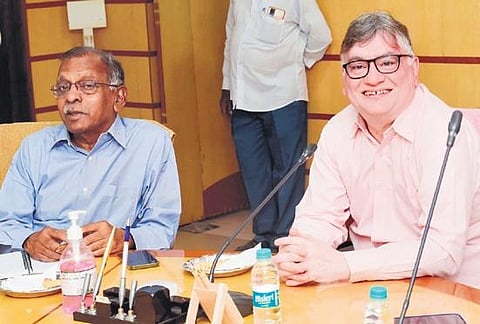
National Dam Safety Authority (NDSA) chairman Anil Jain and his team had a detailed meeting with the State Irrigation officials at Jala Soudha on Wednesday. The NDSA officials questioned the Irrigation officials in detail regarding the designs, quality checks during construction and all other aspects. “The NDSA officials expressed their satisfaction over the design and precautions taken by the Irrigation department,” an official told TNIE.
Official sources said that ‘floating foundation’ method is used for the construction of barrages. Damages caused to the piers of the Medigadda barrage were ‘bound to happen’ at all floating foundations. They pointed out that such incidents had occurred on barrages constructed across the Ganga and also at Dowleswaram barrage in Andhra Pradesh.
Speaking to reporters after meeting the NDSA team, engineer-in-chief C Muralidhar said that foundation undermining could be the reason for the damages to the piers. “There are 11 piers in the seventh block of Medigadda barrage. The central pillar was damaged and its impact was felt on the piers located on either side of the central pier,” the ENC said.He explained that a cofferdam would be constructed to divert the water and later, the officials would start repair works once the floods recede.
Engineer-in-chief C Muralidhar said that the sand near the foundation was disturbed and washed away resulting in the sinking of the pier.Emphasising that there was no fault in the design, Muralidhar said that if it was a faulty design, it would have been known during the floods in the first year itself. “The barrage withstood three consecutive floods in three years with a maximum discharge of 25 lakh cusecs,” he pointed out, adding that the quality of work and design was good.
The officials would now inspect the remaining piers, geology and soil and other aspects, once the floods receded. The NDSA team sought more information on the foundation and other aspects, which would be sent to them soon. Later, the NDSA team would submit a report to the Central Water Commission (CWC).
