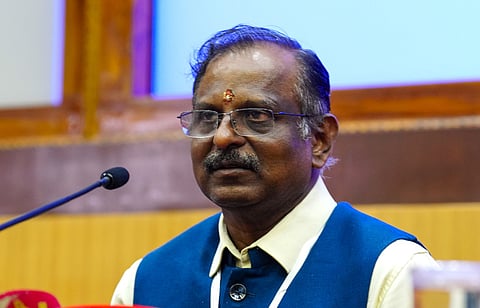

HYDERABAD: The Indian Space Research Organisation (ISRO) is developing a rocket capable of placing a 75,000 kg payload into low earth orbit, ISRO Chairman V Narayanan announced at the 84th convocation of Osmania University on Tuesday.
Delivering the convocation address, Narayanan said the proposed rocket would be as tall as a 40-storey building. “The first launcher, built under the leadership of Dr APJ Abdul Kalam, had a 17-tonne lift-off mass and could place 35 kg in low earth orbit. Today, we are working on a rocket that can carry 75,000 kg,” he said.
Narayanan outlined ISRO’s upcoming projects, including the launch of a Navigation with Indian Constellation (NaVIC) satellite, the N1 rocket, and the placement of a 6,500 kg communication satellite for the United States into orbit using Indian rockets. The agency also plans to launch the Technology Demonstration Satellite (TDS) and GSAT-7R, a military communication satellite for the Indian Navy, this year.
At present, India has 55 satellites in orbit, a number ISRO aims to triple in the next three to four years. Narayanan also referred to the proposed Bharatiya Antariksh Station, a 52-tonne space station expected to be operational by 2035, with initial modules to be launched from 2027. He added that India aims to send an astronaut to the moon and bring them back safely through a fully indigenous mission by 2040.
Leak in rocket before Axiom-4’s launch could have been catastrophic: ISRO chief
Referring to Shubhanshu Shukla’s mission to the International Space Station, Narayanan said a critical leakage in the rocket (Axiom-4) was identified a day before the scheduled launch on June 11, leading to a postponement to June 25. “If the rocket had taken off then, it would have been a catastrophic failure. With Indian involvement in education, training and technical support, the fault was corrected and the mission was carried out safely,” he said.
Narayanan noted that India has launched hundreds of rockets and satellites since 1975, when its first satellite, Aryabhata, was launched with international support.
He said India remains the only country to have succeeded in its first attempt at sending a mission to Mars and holds the record for placing 104 satellites into orbit using a single rocket. “We have the best camera on the moon with 32-centimetre resolution, and we have now built Aditya-L1 to study the sun,” he added.
Addressing graduates, Narayanan urged them to seize opportunities and contribute to India’s growth and to global peace. Osmania University awarded a record 1,261 PhD degrees this year, the highest in the country, along with 121 gold medals for academic years 2022–23 and 2023–24. A new gold medal for the best PhD thesis in English, introduced at the Chancellor’s initiative, was awarded to Palenki, a tribal student.
Governor and Chancellor of Osmania University Jishnu Dev Varma called on graduates to view their degree as a rite of passage and described them as “torchbearers of knowledge and change.” He referred to India’s progress from former Prime Minister Lal Bahadur Shastri’s slogan “Jai Jawan, Jai Kisan” to Prime Minister Narendra Modi’s expanded version, “Jai Jawan, Jai Kisan, Jai Vigyan and Jai Anusandhan.”
Vice-Chancellor Prof. Kumar Molugaram presented a report on the university’s activities.
Navanitha Valluri, who received a gold medal in Mass Communication and Journalism, said: “Every corner of the university carries an aura of motivation which helped me work consistently till my last day here. I am thankful to my parents, sister, department and faculty.”
Arpita, another gold medallist, said: “I am delighted to have received the medal from the Governor and ISRO Chairman. When I learned I would be receiving it from the ISRO Chairman, I was very excited.”
