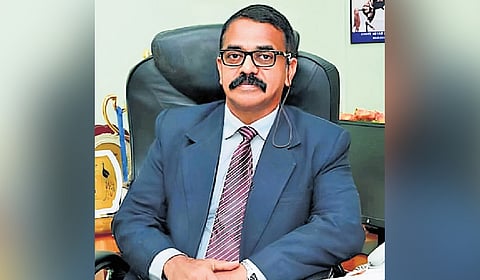

Dr Kishore Gopinathan, a long-time figure in Indian sports administration, now takes on a role as Vice Chancellor of Young India Sports University, Telangana. In an exclusive conversation with TNIE’s Meghna Nath, he outlines his plans to develop the university and expand sports and academic opportunities for the next generation.
What is your vision for Young India Sports University?
We have a vision to offer various academic courses which will help the next generation to get themselves educated in the various sports academic segments, as we have got various segments of sports that include sports coaching, sports management, sports technology, sports sciences, and sports analytics. All the physical education, human performance, indigenous and traditional martial games, all these are in our plan so that the aspirant can get state-of-the-art infrastructure and the latest coaching and training methodologies.
What would be your key focus in the first 100 days in office?
With the 100-day priority, we have planned to set visions, governance, regulatory framework, to have Memorandum of Understanding (MoU) with various national and international premier academic bodies and agencies, launch priority academic programs, recruit core faculty, establish a basic sports science centre, set up of administrative and digital infrastructure, and initiate research collaborations.
What is your proudest achievement in sports education?
I have put in 39 years of service in sports administration and academics and I have joined in 1986 as a lecturer in LNCP, Gwalior. I was also the head of the major academic centres of SAI Centre in Calcutta and Bangalore, and the director of this region.
I was the principal and regional head of the Sports Authority of India, LNCP, Trivandrum for over 15 years and a member of the syndicate and Senate in Kerala University. I was also the director of sports of Kerala on deputation and the secretary of Kerala State Sports Council. During my tenure in Trivandrum, we started operating many courses, graduate, undergraduate and postgraduate, and we got the affiliation of a centre where we produced many PhD.
We also started digital sports education and trained over 75,000 physical education teachers under eKhel Pathshala, which is now growing into a digital platform. Because of this background, I know what the prevailing trends are in sports academics.
How will you leverage sports science and technology, including Artificial Intelligence and data analytics, to enhance athlete performance and academic outcomes?
For this, we have to align it with the training methodology. So we need to have state-of-the-art high-performance centres and sports science labs. So we propose to have this equipment, the latest infrastructure and athlete management systems, AI-driven, and to have sports startups and fitness and wellness centres. One other main factor which we would like to percolate down to the entire Telangana, we don’t want to be limited to Hyderabad. The sports science and technological advancements need to be further disseminated to the entire state and the country.
How do you foster innovation, creativity, and a strong ethical culture within a sports university?
Some of the world’s best sports bodies and incorporated the same in our sports university so that the latest innovations and developments are being taken up, and included in our curriculum.
What are your key priorities for budgeting and resource allocation in the first one to three years?
We’ll start functioning from Gachibowli Stadium and make use of the infrastructure. We have good infrastructure here. We will maybe give some facelift to this infrastructure, later on.
Where do you want to see this university supporting India’s Olympic goals and national sports development in the coming years?
We’ll work in close liaison with the various national and international bodies and sports organisations. Already, I have discussed this with the state Olympic body and also the Indian Olympic Association. PT Usha has assured me all support through the IOA and other apex bodies, because this is very important with the 2030 Commonwealth Games and the 2036 Olympics on the horizon.
We also want the university to establish a formal linkage with the Olympic body so that we can stay informed about various international programmes. This will help ensure that our graduating students are better positioned to secure placements, especially if new opportunities arise in connection with upcoming international sporting events.
