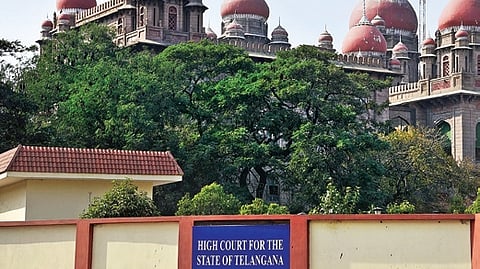

HYDERABAD: Justice Pulla Karthik of the Telangana High Court on Thursday came down heavily on the state government for its alleged failure to comply with Supreme Court directions on appointing a full-time Director General of Police (DGP), warning that it may pass appropriate orders if compliance is not ensured.
The judge questioned the state’s stand and underscored that the directions of the Supreme Court are binding. “First comply with the Supreme Court order. Is it not binding on the state or not?” he remarked, while directing the government to explain its stand. The matter has been posted for December 22 for further hearing.
The court was hearing a writ petition filed by city-based social activist T Dhangopal Rao challenging the appointment of B Shivadhar Reddy as DGP. He contended that Shivadhar Reddy’s appointment in September 2025 was contrary to the 2018 directions of the Supreme Court.
Referring to the landmark Prakash Singh vs Union of India judgment, the petitioner argued that the apex court had categorically ruled that no state shall appoint a police chief on an acting basis. As per the directions, states are required to send proposals to the Union Public Service Commission (UPSC) at least three months prior to the retirement of the incumbent DGP so that a regular appointment can be made from a panel approved by the UPSC.
The petitioner also relied on information obtained under the Right to Information Act from the UPSC, which stated that no empanelment committee meeting had been held for the post of DGP in Telangana. This, according to the petitioner, clearly showed that the state had failed to forward the list of eligible IPS officers to the UPSC, thereby bypassing the mandatory legal procedure.
He further sought to quash the Telangana Police (Selection and Appointment of DGP) Act, 2018, terming it a colourable piece of legislation that runs contrary to the Supreme Court’s mandate.
Opposing the plea, Advocate General A Sudarshan Reddy submitted that a panel of officers had indeed been forwarded to the UPSC. However, he said the UPSC had sought certain clarifications and, in the meantime, some officers included in the panel had retired, complicating the process.
The Advocate General also contended that a writ of quo warranto, questioning the authority of the incumbent DGP, was not maintainable in the present case. If there was any alleged violation of Supreme Court directions, he argued, the appropriate remedy would be to initiate contempt proceedings before the apex court.
While acknowledging that the State is bound by the Supreme Court’s directions, the Advocate General informed the court that he would seek detailed instructions from the government.
The court declined to grant any interim relief at this stage, but observed that if the state had complied with the Supreme Court’s directions, it should place the material on record. Justice Karthik directed the Advocate General to file written instructions and adjourned the matter.